

































Sawsan Zaher is an independent Palestinian human rights lawyer based in Haifa. She serves as a legal advisor and is active in several Palestinian human rights and feminist organizations. Sawsan has extensive experience in constitutional strategic litigation on behalf of Palestinians before Israeli courts. Notably, she recently represented the Palestinian Authority in a constitutional petition before the Israeli Supreme Court regarding the freezing of Palestinian tax revenues. She also serves as a co-supervisor at the human rights clinic in Tel Aviv University. Previously, Sawsan served as the Deputy General Director and Senior Lawyer at Adalah, where she practiced for 16 years.
Much has already been written on the racist character and draconian norms embodied in Israel's new death penalty law approved on March 30. The law deliberately applies exclusively to Palestinians, creating a punitive ethno-national system in which one blood is deemed more valuable. However, it cannot be viewed as merely another discriminatory piece of legislation but rather should be recognized as an integral component of a broader mechanism of dehumanization that establishes the intent to destroy the Palestinian people.
The starting point for understanding this law lies not only in the committee rooms and plenary sessions of the Knesset, but in decisions of international tribunals that have already addressed the dehumanization inherent in the Israeli state's treatment of Palestinians. In establishing the "specific intent" required for the crime of genocide committed by Israel in Gaza, the International Court of Justice (ICJ), in its decision of Jan. 26, 2024, issuing provisional measures meant to immediately end Israel's actions, pointed to a series of dehumanizing statements by Israeli political leaders.
Central to that case are the remarks of Israeli Prime Minister Benjamin Netanyahu, who supports the law and will sign it into force. In October 2023, he invoked the biblical command "Remember what Amalek has done to you" — a metaphor calling for total annihilation — alongside declarations by Defense Minister Yoav Gallant referring to Palestinians as "human animals." The ICJ identified in these statements a reasonable basis for the existence of the criminal intent necessary to substantiate allegations of genocide and justify provisional measures.
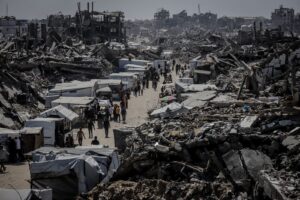
The connection between the policy of starvation in Gaza and the death penalty law is one of shared essence: the denial of Palestinians' right to life through the rejection of their humanity.
- Sawsan Zaher
The positive obligation to prevent incitement against Palestinians occupied a central place in the court's order, given Israeli leaders' role in facilitating genocide. The ICJ mandated that Israel "take all measures within its power to prevent and punish" such statements, obligating Israeli law enforcement and judicial authorities to take criminal action against inciters — including public officials.
The enactment of a discriminatory death penalty law based on national identity constitutes an affront to that decision. Instead of prosecuting those inciting against Palestinians, the Knesset chose to transform dehumanization into official legal procedure. The completion of this legislative process was marked by explicit symbolism reflecting the genocidal mentality of Israel's political leadership. Minister of National Security Itamar Ben-Gvir — overseeing the prisons holding Palestinians potentially subject to this law — celebrated by opening a bottle of champagne in the Knesset after the vote. Similarly, Member of Knesset Limor Son Har-Melech described it as a "day of good news" and a "day of historic justice."
International recognition of this deliberate policy of incitement and dehumanization was further reinforced by the rejection of Israel's appeal before the International Criminal Court (ICC) against the issuance of arrest warrants for Netanyahu. In its decision on Dec. 15, 2025, the ICC affirmed that there is substantial evidence of a plan to systematically harm the civilian population through persecution and starvation. According to the court, Israel's deprivation of the fundamental rights of Palestinians — foremost being the right to life and basic conditions of existence — is not an incidental byproduct of warfare, but a deliberate policy directed against them, constituting an expression of systematic destruction.
That assessment likewise grounded in Israeli political leadership's dehumanizing rhetoric, rendering the death penalty law a complementary legal instrument within the same ideological policy framework. It is designed to provide legal cover for the physical elimination of Palestinians under the guise of criminal procedure. The connection between Israel's policy of starvation in Gaza and its death penalty law is one of shared essence: the denial of Palestinians' right to life through the rejection of their humanity.
The international community must adopt positive measures of restraint, demanding genuine accountability and lifting the immunity shielding crimes committed against Palestinians.
- Sawsan Zaher
Under the Genocide Convention, destruction may be carried out through the creation of conditions of life calculated to bring about physical destruction — such as starvation — or through direct killing. In this sense, starvation constitutes a collective, slow and silent execution, whereas the death penalty law represents the swift judicial gallows. Both derive from the same criminal intent identified by international courts. If the state claims the authority to starve millions of Palestinians in Gaza, it is unsurprising that it now seeks the authority to execute Palestinians in Israeli prisons via a mandatory death penalty, stripping judges of discretion and prohibiting sentence mitigation — including clemency.
An additional domestic judicial layer must be considered. In a ruling issued by the Israeli High Court of Justice in March 2025, rejecting petitions by human rights organizations to allow humanitarian aid into Gaza, Supreme Court Justice David Mintz echoed the rhetoric of political leaders and infused it with religious-national content. In dismissing the petition, Mintz referred to Israel's campaign as a "commanded war" against "Amalek."
The link between Mintz's ruling and the death penalty law approved one year later centralizes the same components. When a Supreme Court justice invokes the term Amalek, they legitimize political rhetoric dehumanizing Palestinians. In a "commanded war" against "Amalek," the state's obligations are not derived from human rights, but from a perceived command of annihilation.
In this context, recall that two months after the court rejected the humanitarian aid petition, the same human rights organizations filed a renewed petition demanding that the state allow aid into Gaza. In September 2025, after observing that the court was not expediting the case and was granting the state repeated extensions to respond, the organizations withdrew their petition and, for the first time, requested that it be dismissed without adjudication. They argued that the court's policy of "endless delays" amid starvation in Gaza meant that it no longer functioned as a judicial body but as an instrument granting "legal approval" to Israeli policy — effectively facilitating the commission of genocide in Gaza. It is no coincidence that the ICC's December 2025 decision rejecting Israel's appeal against Netanyahu's arrest warrant also dismissed Israel's claim of complementarity, reasoning that the Israeli judicial system could no longer fairly adjudicate justice for violations against Palestinians.
This policy of endless delay may have been replicated in the High Court's first decision against petitions challenging the death penalty law and seeking interim relief to suspend its implementation. The following day, Justice Yehiel Kasher refused to issue a temporary injunction halting the law's implementation, granting the State Attorney's Office an extended period until the end of May 2026 to respond. While the court grants the state two months to reply, the execution mechanism comes into force.
The law itself establishes a draconian timetable enabling executions within as little as 90 days. This is not merely a procedural decision. The refusal to issue an immediate injunction constitutes the procedural-judicial implementation of the Amalek doctrine against Palestinians. Within a framework of dehumanization, there is no legal urgency to protect Palestinian life — neither from starvation nor execution. Thus, a unified front emerges across all state branches: The government defines the motive and intent; the Knesset translates intent into repressive legislative frameworks; and the judiciary provides the procedural and legal framework legitimizing the ideological structure.
In a reality where dehumanization is openly declared and embedded across the Israeli authorities, the international community must adopt positive measures of restraint, demanding genuine accountability and lifting the immunity shielding crimes committed against Palestinians. Silence, or reliance on mere rhetoric as death transforms into legal procedure, is not a diplomatic failure; it constitutes a breach of the international obligation to prevent genocide and grants impunity to a project of persecution. States must adopt concrete enforcement measures that illustrate to the Israeli government that impunity for dehumanization and persecution carries real international consequences — before this new law claims its first victims.
The views and positions expressed in this article are those of the author(s) and do not necessarily reflect the views of DAWN.