

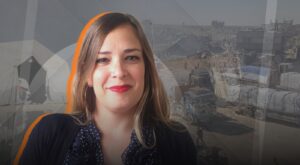



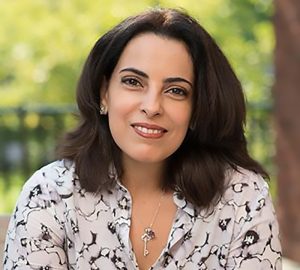


Rena Netjes is a Dutch journalist and researcher who has reported extensively from Syria throughout its war. She was previously the Cairo correspondent for Parool newspaper and BNR radio in the Netherlands.
Amouda — a small town in northeast Syria near the Turkish border — has no high-rise buildings, and not by accident. The Assad regime never allowed them to be built. The town, which locals describe as approximately 99% Kurdish and west of Qamishli City in northeast Syria, was known for its strong opposition to Assad.
Posters of Kurdistan Workers' Party leader Abdullah Öcalan or former Syrian President Bashar al-Assad cannot be found here, as they are in Qamishli and Hasakah. Those can only be found inside Kurd-led Democratic Union Party (PYD) educational centers and their People's Protection Units (YPG) militia training camps.
Walking through Amouda in September and October 2019, poverty was everywhere. At night, there were no lights at all — a stark contrast to the glow of Mardin, perched on a hill on the other side of the border in southeast Turkey.
In a pharmacy in neighboring Qamishli, I saw people arriving with yellow or gray skin — signs of severe illness I had never encountered before. Some houses in Amouda had collapsed as a result of Syrian Democratic Forces (SDF) tunnel-digging activities. I visited a widow living with her two handicapped children in a single room of what had once been their house. That room was still habitable; the rest had sunk because of the tunnels.
To travel farther west to Ein Issa in northern Raqqa Governorate — where an important meeting with SDF leaders was expected at the time — we first had to go to the local PYD press office to obtain a permission paper. One of the guards at the entrance of the complex was a shy girl of about fourteen. She was tasked with frisking me, checking whether I was carrying weapons. She looked more frightened than I was feeling. Seeing her there made it clear that, despite official denials, the YPG were recruiting young girls.
The group played a major role in the civil war. When the Syrian uprising reached Kurdish areas, the PYD suppressed anti-Assad demonstrations after striking a 2012 deal with the regime for control of most Kurdish-majority regions. The deal effectively neutralized Kurdish participation early in the revolution, a bitter irony for a community long denied basic rights under Ba'athist rule, leaving simmering tensions that ultimately exploded last month.
This dynamic presented itself in Amouda in 2013, when local residents — exclusively Kurds — took to the streets to protest against the regime. The demonstration was met with YPG gunfire, killing six demonstrators, among them local members of the opposing Kurdish National Council (KNC). Although the PYD later issued an apology, those responsible have never been held to account.
"We are very anxious here, they are in Hasakah province now," Vivian, a local activist in Amouda, told me on Jan. 19, describing the year-old transitional government's assault on the PYD-controlled Syrian Democratic Forces (SDF) and their territorial holdings in northeast Syria. "They released ISIS prisoners from Shaddadi prison. We don't know exactly who was responsible, but we are afraid — afraid of massacres, afraid of chaos."
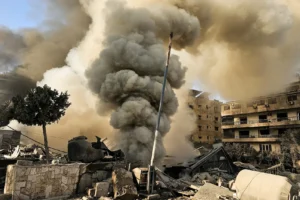
Displacement and the humanitarian crisis long plaguing Syria are visible throughout Amouda.
- Rena Netjes
Accounts of what happened differ. Each side accuses the other of chaotic handovers, fleeing guards or deliberate negligence that allowed prisoners to escape. Several prisons held a mixed population — including political detainees, common criminals and Islamic State members. What is certain is that some of the escapees remain at large. In the northeast's Deir Ezzor Governorate, IS attacks in recent days killed at least two people.
"YPG is calling for a general mobilization here," Vivian said. "Young Kurdish men continue to be forcibly conscripted and killed. But people are not joining them, people are getting arrested. They take them against their will. Many are minors. They are not PKK, but they are forced to fight. It is shameful."
Just days earlier, Arab tribal fighters — previously constituting an estimated 65-70% of the SDF, though rarely credited for the fight against IS — defected en masse. The move opened the gates for the central government's rapid advance, effectively ending the SDF project. Overnight, the group was reduced largely to its YPG core in major cities across the northeast.
The SDF —a U.S.-created force established in 2015 and lavishly funded and armed to fight IS — lost roughly 75% of its territory in just 48 hours. The speed of the collapse surprised many observers. Yet on closer inspection, the unraveling was neither sudden nor accidental.
When I left Damascus on Dec. 30, year-old talks were still ongoing between SDF leader Mazloum Abdi and interim Syrian President Ahmad al-Shara'a. One of the figures involved in arranging the initial meeting was clear about its contents: "Abdi asked [for] an extension of the 10 March agreement of six months and al-Shara'a refused. Then he asked for three months; he refused again.
"Al-Shara'a gave him until mid-January. Abdi said he needed to consult with some people in Qamishli and elsewhere in northeast Syria," the source said.
"There are several reasons for the rapid collapse of the SDF," explains Azad Osman, former member of the Syrian Opposition Coalition and director of the Association of Syrian Independent Kurds. "We heard through multiple leaks that the Americans demanded an SDF withdrawal without fighting, and that this was tied to the Paris agreement," reportedly reached between Damascus and the United States on the sidelines of the last round of Israel-Syria talks in France on Jan. 5.
Clear warning signs for the SDF flashed for years. In Eastern Deir Ezzor, protests against repression have persisted since the SDF's 2019 defeat of IS in Baghouz. Similarly, the SDF crushed an August 2023 armed revolt in the governorate. Many young Arab men — including minors — have fled north in recent years, traveling via Turkey for Europe to avoid conscription into either the previous Assad regime or SDF." If you look at a market, you hardly find young men," a 62-year-old Ogeidat sheikh who fled north told me in September 2023.
In Damascus in October 2025, I encountered several young Arab men from Hasakah, including a minor, running a supermarket. The owner said his friends were arrested at a checkpoint for having a photo of the fall of the Assad regime on their phones.
The minor, his cousin, had arrived four days earlier after four friends were forcibly conscripted to the frontlines in Deir Ezzor. When I visited them again in December, one said, "One of my friends died 10 days ago on the frontline."
The rupture between the SDF and its Arab allies had thus been building for months, and arguably longer. In October, activists from eastern Syria said during a meeting in Damascus that the SDF was distributing weapons in Raqqa. "The tribesmen take them," one said, "but one day they will use them against the SDF." That day came on Jan. 17 with the central government's assault.
Vivian described a similar landscape of long-term neglect and deprivation in Amouda. "They haven't done anything for us. We have no electricity, no regular water, ruined streets, houses damaged by tunnels. Fuel used for heating is polluted and causes disease," she said.
"What did they give us? Nothing — not to Kurds, not to Arabs. We are all oppressed."
Electricity in the city is almost non-existent. Residents rely on private generators that provide power for only a few hours a day, while many households now utilize solar panels. Internet access is similarly unstable: "It comes and goes," Vivian said. "Even Facebook stopped working."
Over the years, I have exchanged messages with Kurds in Amouda, alongside other Kurd-majority cities like Qamishli and Deirik in the northeast. More than once, they have apologized after days of silence: "Sorry Rena for my late reply, we didn't have electricity for three days."
When I visited the area in September 2019, I observed in Amouda that residents were subjected to a dual electricity system: one hour of power supplied by the Syrian government, and at certain points during the day, an additional hour provided by the SDF. On some days, however, there was no electricity at all.
That was when the Assad regime was still present. In recent months, residents described worsening conditions. "We used to get one hour of electricity a day from the regime," one said. "Now we get nothing," mostly due to disagreements between the SDF and Damascus.
Yet Vivian similarly expressed deep skepticism toward Damascus's political promises regarding Kurdish rights. "We want peace, not war," she exclaimed. "We are exhausted psychologically. But where is the recognition of Kurds as original inhabitants? Now they say Kurdish will be optional in schools — only two lessons a week."
"They treat us like a diaspora, even though Kurds make up 15-20% of Syria," she explained.
Demographics — particularly in Hasakah Governorate — are a highly contentious topic, debated regularly. Arabs and Kurds often disagree over population figures, with divisions within each community as well. Estimates vary widely: Many governments and local observers estimate the Kurdish share of the population at 10% nationally, though no precise data exist.
"Hasakah is a vast governorate, and when treated as a single region, Arabs today outnumber Kurds. Kurdish political actors, however, contest this characterization, arguing that the demographic balance was altered by state policy in the 1960s," says Osman.
He is referring to the so-called Arab Belt project, "Initiated during the period of Gamal Abdel Nasser and later implemented by the Ba'ath Party, in which Arab tribes were resettled along the Syrian-Turkish border." According to Osman, "The stated aim was to create continuous Arab-dominant population centers that would prevent Kurdish-majority areas from forming a contiguous zone. A similar, though more limited, policy was applied in Afrin, where Arab communities remain numerically small."
Meanwhile, humanitarian assistance has come not from the local authorities but from independent organizations. "The Barzani Foundation helped the displaced — Arabs and Kurds alike," Vivian said. "They distributed diesel and food and opened schools for shelter."
Despite the dire situation, residents still hope — cautiously — that the existing ceasefire agreement will prevent further bloodshed.
- Rena Netjes
Displacement and the humanitarian crisis long plaguing Syria are visible throughout Amouda. Families from Hasakah and surrounding villages — Kurds and Arabs — crowd into schools or stay with relatives. To help allay the issue, the Barzani Charity Foundation on Jan. 26 reported that it delivered 133 truckloads of food and non-food aid to Qamishli, Amouda, Girke Lege (Maabada) and Deirik, reaching 7,506 families and 46,421 individuals in total. The aid included food baskets, mattresses, blankets, hygiene kits, fuel, hot meals and medical treatment, alongside temporary employment opportunities.
On local Facebook pages, residents continue to complain about collapsing infrastructure. "But they were good at digging tunnels," one Kurdish activist wrote, concluding with an insult: "The losers."
For some, the wrangling between Damascus and the SDF perpetuating widespread humanitarian difficulties appears choreographed, with deals in place to address efforts to fully unify the country after its 14-year civil war. "I believe what we are witnessing is political theater," Osman said, noting that the text of the Paris agreement has not been publicized.
"The government lacks transparency, and no one knows exactly what was decided," he says. "But we received information that the conference aimed to extend state authority at this stage while recognizing the Kurdish component." According to Osman, the agreement envisioned a form of decentralization: Hasakah and Qamishli administered by Kurds, with SDF fighters absorbed into the Syrian army "as individuals, not as a block," alongside Kurdish participation in local administration. An initial mid-January ceasefire reflected those terms.
"The PYD/SDF and the government appear to be acting within a pre-arranged scenario shaped by an undeclared agreement, likely brokered under external pressure," Osman argued. "While the details remain hidden, its effects are already visible."
As such, Osman did not expect a full-scale war: "There may be limited clashes, but not a decisive confrontation. Talk of entering areas, disarming Kurdish forces or of large-scale resistance is unconvincing."
In Kobani, U.N.-escorted aid convoys from Aleppo began delivering food, blankets and fuel on Jan. 25 — marking the first such deliveries since fighting escalated. Still, shortages remain acute. "Today, the second inter-agency convoy arrived in Ain al-Arab/Kobani following close coordination with local authorities," the U.N's humanitarian aid arm last reported on Feb. 5 that, although the situation is stabilizing, "Basic services in affected rural areas remain largely disrupted."
That stabilization largely started days after the peak of the fighting on Jan. 27, when Vivian said that the central government had besieged Kobani, Amouda, Qamishli and other Kurdish majority and minority towns, alongside their surrounding areas. Limited humanitarian corridors remained open, with one between Hasakah and Damascus and another from Kobani — further to the west and cut off from the territory primarily held by the SDF — mainly for medical cases.
"We are very worried. My sister is ill and cannot walk. We don't go out here unless necessary," Vivian explained. "Many displaced families are arriving from villages around Hasakah."
Yet despite the dire situation, residents still hope — cautiously — that the existing ceasefire agreement will prevent further bloodshed. "We lived very worrying days," said Vivian. "We only hope this agreement is real."
That new SDF-Damascus agreement was signed on Jan. 30. One contact close to the government described the situation in a brief interview: "Lists of names from General Security are currently being prepared. We don't want clashes between extremist elements and SDF elements. We are trying to select people carefully."
That same evening, Vivian said that the situation in Amouda remained calm. "We are fine. There is nothing happening here." At the time, she said security forces affiliated with Damascus were expected to enter Qamishli as part of an agreed arrangement. They ultimately did enter on Feb. 3.
"They will enter normally," she predicted at the time, noting a curfew was imposed in Qamishli the following day. She did not expect unrest or violence: "I don't think there will be problems, because the SDF and the government have agreed with each other."
On Feb. 3, residents of Tel Hamis and Tel Barak, neighboring villages west of Amouda in southern Qamishli District, welcomed the entry of Syrian government forces. The area has witnessed prolonged violence in recent years, involving first the Islamic State and then the SDF.
In Qamishli City, amid the curfew, the streets were largely empty except for members of the YPG and Kurdish media outlets, some chanting slogans such as "Bijî Kurdistan" and "Long live Kurdistan" as Syrian troops entered the city. Yet, despite the tense atmosphere, an unexpected political development unfolded — one that had seemed unlikely only weeks earlier.
A delegation from Syria's Ministry of Interior held a meeting, followed by a press conference, with representatives of the Asayish — the Kurdish internal security forces affiliated with the PYD and YPG. Speaking at the press conference, Deputy Minister of Interior Nour al-Deen Baba described a "positive atmosphere."
"The Minister of Interior is currently being received by the Asayish at their headquarters in Qamishli, with the aim of deploying government forces throughout the city to assist the Asayish in maintaining security, in accordance with the agreement reached between the SDF and the Syrian government," Baba explained. "What I have seen and truly witnessed is a very positive atmosphere from all sides, and this — thank God — is exactly what the Syrian people need."
"Today we begin a new chapter and start building a new Syria, far from delays, far from hate speech and far from divisive rhetoric. Syria is built by all its sons — Arabs, Kurds, Turkmen, Syriacs and others. Syria needs everyone."
One can only hope that this spirit of goodwill on both sides prevails. At the very least, a military confrontation no longer appears imminent, even if some radical factions on both sides remain uneasy with the unfolding developments.
The armed conflict in Syria's northeast may have subsided, but a political struggle is now beginning. Kurdish actors have presented a set of demands, while other communities — most notably the Assyrians — are also pressing for recognition of their cultural and linguistic rights, including official acknowledgment of the Assyrian (Aramaic) language.
Whether Syria's rich mosaic of factions and ethnic groups choose political solutions to inherently political problems remains to be seen after such a brutal conflict. Only time heals, but for Syrians in Amouda, true peace and their country's reconstruction cannot come soon enough.
The views and positions expressed in this article are those of the author(s) and do not necessarily reflect the views of DAWN.