
















First Amendment Lawsuit Challenges Use of Sanctions to Bar Engaging With the ICC, Palestinian NGOs, UN Expert
(New York, NY, July 15, 2026) — The Trump administration's sanctions targeting the International Criminal Court (ICC) violate Americans' constitutional right to engage in Palestine-related human rights advocacy, Democracy for the Arab World Now (DAWN) and the Taxpayer Alliance Against Genocide (TAAG) charged today in a lawsuit filed in federal court in Manhattan. The lawsuit follows U.S. Secretary of State Marco Rubio's latest threat to dismantle the ICC, including in a July 13 Wall Street Journal op-ed that references DAWN's advocacy for international justice.
While ostensibly directed at foreign persons, the sanctions unconstitutionally restrict Americans from seeking justice on Palestine at the ICC and working with human rights defenders designated solely for calling on the ICC to investigate Israeli and American nationals.
"The Trump administration is using the blunt instrument of economic sanctions not only to punish human rights defenders but to police the political expression of millions of Americans," said Omar Shakir, executive director of DAWN. "The government is violating the constitutional rights of American citizens in order to shield officials of a foreign government who have committed a genocide."
Executive Order 14203, issued in February 2025, grants administration officials the power to impose sanctions on foreigners for supporting the ICC's investigations into U.S. and Israeli nationals for war crimes, crimes against humanity, and genocide and makes it a federal offense to provide a "service" to—or receive one from—a sanctioned individual or entity. It does so by declaring that such investigations constitute a "national emergency," based on false claims that the ICC lacks jurisdiction over crimes committed by U.S. and Israeli nationals and that those countries "strictly adhere to the laws of war."
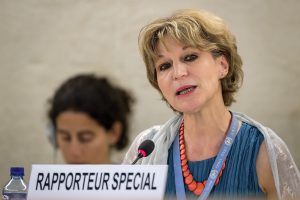
Under Executive Order 14203, the Trump administration has sanctioned ICC prosecutors and judges, as well as leading Palestinian human rights groups al-Haq, al-Mezan and the Palestinian Center for Human Rights (PCHR) and the UN Special Rapporteur for the Human Rights Situation on the Occupied Palestinian Territory Francesca Albanese. Because the government can interpret the term "service" to encompass anything that confers a benefit on the recipient, groups like DAWN and TAAG could face civil and criminal charges if they engage in routine advocacy with the sanctioned parties—for example, filing a brief with the ICC encouraging it to investigate possible crimes, sharing evidence or advocacy ideas with Palestinian human rights groups or Ms. Albanese, or working with them on a campaign to lift the sanctions. Faced with that threat, DAWN and TAAG—like many Americans—have been forced to self-censor. Many groups have halted their ICC-facing work and severed professional ties with the Palestinian human rights groups and Ms. Albanese.
The lawsuit contends that the sanctions violate the First Amendment both by limiting what Americans can say to an international tribunal or to foreign advocates, as well as by limiting their ability to associate with the sanctioned parties. It further argues that the executive order exceeds the president's statutory authority under the International Emergency Economic Powers Act (IEEPA), which bars the president from using sanctions to restrict "personal communications" or the transmission of "information or informational materials."
The lawsuit seeks a court order barring the administration from using the executive order to prevent U.S. citizens from supporting investigations into U.S. and Israeli abuses, and from working with sanctioned human rights defenders.
"Congress wrote safeguards into the law to prevent it from being used as a cudgel to silence viewpoints that the government finds unfavorable and the Trump Administration has blown past those restraints," said Joseph Pace of J. Pace Law, PLLC, plaintiffs' counsel. "The U.S. government has the largest megaphone in the world and it is perfectly capable of pleading its case—or Israel's. What it cannot do is bar Americans from sharing a contrary perspective with the ICC, much less criminalize contact with non-American human rights defenders whose only 'misdeed' was calling for justice for U.S. and Israeli crimes."
Several other challenges to the ICC sanctions have been filed to date. This, however, is the first lawsuit that seeks to prevent the Trump administration from using sanctions law to bar Americans from supporting the ICC's investigations into U.S. and Israeli atrocity crimes, or from working with Ms. Albanese and the sanctioned Palestinian NGOs.
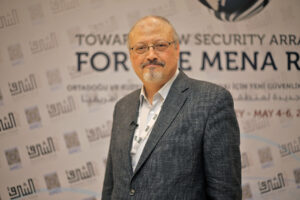
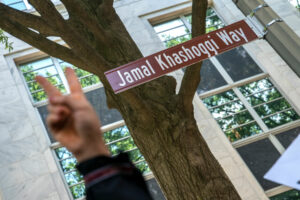
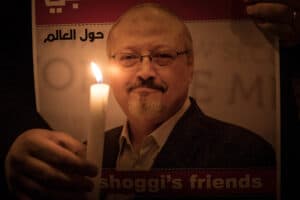
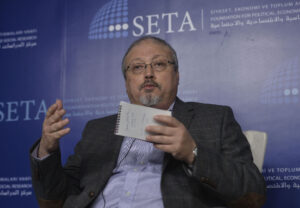
DAWN, the legacy organization of the late Saudi journalist Jamal Khashoggi, works to promote human rights and combat impunity across the Middle East and North Africa. In recent years, DAWN has conducted significant research and advocacy to hold Israeli and U.S. officials accountable for grave abuses. This includes multiple submissions to the ICC: a 2022 filing regarding the Israeli army's Netzah Yehuda Battalion; a 2023 submission identifying Israeli military commanders active in the Gaza war; and a 279-page January 2025 filing asking the prosecutor to investigate former U.S. President Biden and Secretaries Blinken and Austin for aiding and abetting crimes for which the ICC has issued arrest warrants against Israeli Prime Minister Benjamin Netanyahu and former Defense Minister Yoav Gallant.
Many of DAWN's activities have relied heavily on collaborative research and evidentiary exchanges with Palestinian civil society and United Nations officials. DAWN has for years engaged in joint advocacy and public engagements with the designated Palestinian NGOs and Ms. Albanese.
TAAG is an association that was formed to prepare and submit communications to the ICC prosecutor documenting the role of U.S. officials in committing—or aiding and abetting the commission of—war crimes, crimes against humanity, and other grave abuses, and to engage in related research, educational, and advocacy efforts in support of accountability for those abuses. As a result of the sanctions, TAAG has been forced to abstain from making ICC submissions.
Earlier this year, both plaintiffs sought clarification from the Office of Foreign Assets Control (the Treasury Department office that administers the sanctions) that their proposed activities are protected by the First Amendment and permissible under the sanctions regime. Members of TAAG sought OFAC confirmation on February 17, 2026; DAWN sought confirmation on March 31 and again on May 5, 2026. OFAC has not responded.
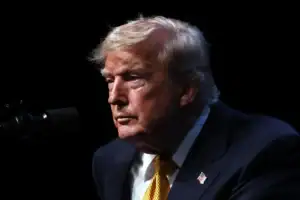
The defendants, sued in their official capacities, include President Donald J. Trump, Secretary of State Marco A. Rubio, Secretary of the Treasury Scott Bessent, Acting Attorney General Todd Blanche, and OFAC Director Brad Smith.
"With this executive order, Trump has put himself and those in the U.S. government above the law, shielding them from any accountability for their roles in the genocide in Palestine and Lebanon and for war crimes around the globe funded by U.S. taxpayers," said Tarik Kanaana, president of TAAG. "As U.S. taxpayers, we have the right to hold our government accountable for how it uses this public resource. That right cannot be taken away."