

































(Washington, D.C., May 20, 2026) — Staff at the American Israel Public Affairs Committee (AIPAC) maintain strong connections to the Israeli and U.S. governments and the broader pro-Israel ecosystem in the U.S., said DAWN today in releasing new data mapping the professional connections of more than 3,000 current and former AIPAC staff.
The data demonstrates a revolving door relationship between AIPAC and U.S. and Israeli governmental institutions, with dozens of current and former AIPAC staff having worked for Israeli or U.S. government bodies.
AIPAC operates one of the largest lobbying and electoral operations in Washington and holds federal tax-exempt status, but does not publicly disclose the identities of its staff or the structure of its workforce. The new data, obtained through voluntary disclosures on LinkedIn, sheds light on some of the ways in which AIPAC connects Israeli governmental institutions and the larger pro-Israel ecosystem to the U.S. government and political party apparatuses.
[For more information go to: http://aipacwhoweare.org/]
"AIPAC shapes U.S. policy in the Middle East, but operates entirely in the shadows," said Omar Shakir, executive director of DAWN. "AIPAC's tax-exempt status means that American taxpayers effectively subsidize the pro-Israel lobby and they deserve to know how AIPAC works and who works for it."
In December 2025, DAWN published "The Faces of AIPAC," which identified the 50 officers and directors who run AIPAC. Developed in partnership with analyst Matthew Penn of Eagle Mission, an independent open-source intelligence initiative that maps the institutional structure of the pro-Israel lobby in the United States, this new data set provides a more complete picture of AIPAC's reach and influence.
The network analysis is built on current and former AIPAC staffers' LinkedIn profiles and their thousands of connections to government bodies, think tanks, universities, and political apparatuses. Eagle Mission has assembled a dataset covering nearly 400,000 individuals and their self-disclosed employment histories and more than 2,000 organizations, comprising over 1.2 million professional connections. A "connection" in the dataset is defined as an individual AIPAC staff member who added a person from another organization as a contact or friend on their own LinkedIn profile. The analysis counts those connections and groups them by institution.
AIPAC represents one of the least transparent modes of influence on U.S. foreign policy and its scope is incredibly difficult to understand without transparency around staff members' identities, employment histories, and professional connections. The 3,020 individuals identified in this analysis represent only a partial sample of AIPAC's current and former workforce. Many AIPAC staff do not maintain LinkedIn profiles; of those who do, many only partially list their employment history and affiliations with government bodies and other organizations.
"Everything in this dataset came from information AIPAC's own current and former staff chose to make public on their professional profiles," said Matthew Penn of Eagle Mission. "The public should not have to rely on LinkedIn profiles to understand how a political juggernaut operates."
AIPAC, a 501(c)(4) nonprofit organization incorporated in Washington, D.C., functions as a network of networks. Its ability to lobby and shape U.S. foreign policy so successfully over the years is made possible partially by the relationships it maintains with the U.S. government, the Israeli government, think tanks, and the broader ecosystem of pro-Israel organizations in the U.S.
AIPAC's workforce moves through the institutions it lobbies and the institutions it lobbies for. For example, David Gillette, who is currently AIPAC's Executive Vice President for Policy & Government Affairs, previously served as a Deputy Assistant Secretary at the U.S. State Department. Ira Forman, formerly an AIPAC staff member, previously served as the U.S. State Department's Special Envoy to Monitor and Combat Anti-Semitism.
DAWN's analysis shows that 66 former AIPAC staffers currently work in the U.S. government, from Congress to the White House to various branches of the military; nearly two dozen current AIPAC staffers previously worked in U.S. government bodies. The personal and professional relationships that result from this type of revolving door form the backbone of political influence in Washington, which is indicated in the hundreds of professional connections between AIPAC staffers and U.S. federal and state employees. This is, of course, in addition to the more official channels of lobbying and influence.
Of the 66 former AIPAC employees who currently list employment with the federal government, 40 now work in Congress, including in influential bodies like the House Foreign Affairs Committee. Likewise, of the 23 current AIPAC staffers who list U.S. government experience, 17 previously worked in Congress. The revolving door also feeds through the Department of State, the Department of Defense, various branches of the military including U.S. Central Command, which is responsible for overseeing military ties with Israel, and the Department of Commerce.
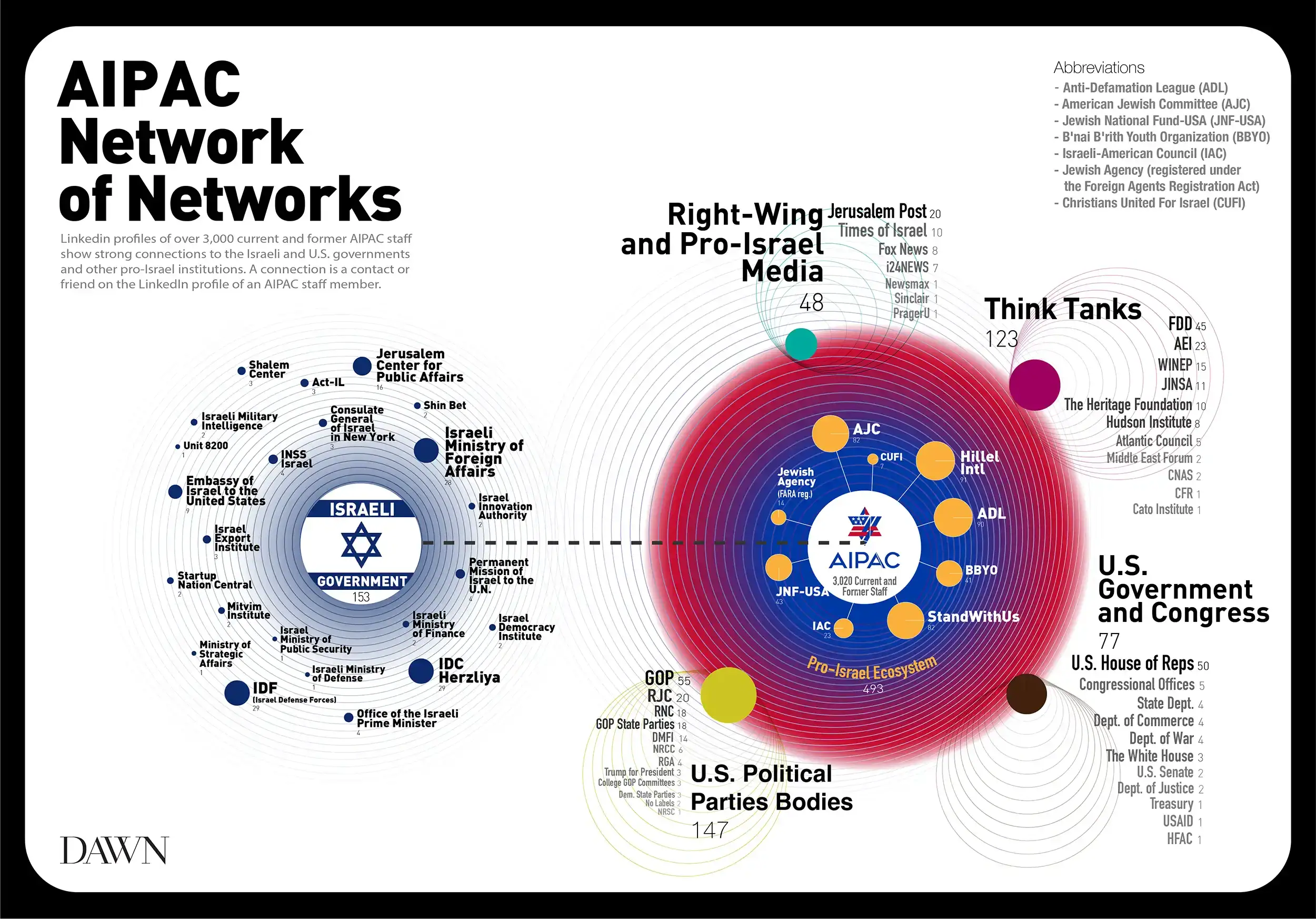
Likewise, the data DAWN analyzed reveals many connections to Israeli government institutions. Seven former AIPAC staffers currently work for Israeli government institutions and six current AIPAC staffers previously worked for Israel, according to the analysis. This is on top of 153 LinkedIn connections which show ongoing relationships between individuals working for AIPAC and the Israeli government, respectively. These LinkedIn connections include 44 connections with current or former employees of Israel's Ministry of Foreign Affairs and its various diplomatic missions in the United States, four in the Israeli Prime Minister's Office, and 29 with the Israel Defense Forces, including Israeli military intelligence.
The data also shows that AIPAC staffers and leaders maintain professional connections and move across virtually every major pro-Israel institution in the United States, including prominent think tanks and advocacy organizations. Among the hundreds of staffers moving between these institutions, 45 moved between AIPAC and various Jewish Federations, 25 with Hillel International, 18 with the Foundation for Defense of Democracies (FDD), and 16 with the Anti-Defamation League (ADL).
In addition, the dataset shows 493 professional connections between current and former AIPAC staff members and employees of pro-Israel advocacy organizations that present themselves to the American public as institutionally independent of AIPAC. This includes 91 connections with Hillel International, 90 with the ADL, 82 with the American Jewish Committee (AJC), 82 with StandWithUs, 43 with the Jewish National Fund-USA (JNF-USA), 41 with B'nai B'rith Youth Organization (BBYO), 23 with the Israeli-American Council (IAC), 14 with the Jewish Agency for Israel, and seven with Christians United for Israel (CUFI). The data also shows 123 professional connections with think tanks, including 45 with FDD, 23 with the American Enterprise Institute (AEI), 15 with the Washington Institute for Near East Policy (WINEP), 11 with the Jewish Institute for National Security of America (JINSA), 10 with the Heritage Foundation, and eight with the Hudson Institute.
The data also shows that AIPAC is far more connected with the Republican party establishment than the Democratic party. Fourteen current AIPAC staffers list previous employment with the Republican party, while only two worked for Democratic party bodies. Current and former AIPAC staffers maintain LinkedIn connections with 55 individuals in the Republican Party, 20 with the Republican Jewish Coalition (RJC), 18 with the Republican National Committee (RNC), 18 with state Republican parties, six with the National Republican Congressional Committee (NRCC), four with the Republican Governors Association (RGA), and three with College Republican organizations. There also were 14 connections with individuals who work with the Democratic Majority for Israel (DMFI), an Israel-focused Democratic group, and three with state Democratic parties.
AIPAC says it is "an American organization," "funded by" and "directed by Americans" that takes no direction from any foreign government. Among its reported activities, AIPAC lobbies Congress and the executive branch to advance pro-Israel policies, including directing billions of dollars in annual U.S. military aid to Israel and opposing any conditionality on weapons transfers, and any accountability measures against Israeli officials. AIPAC also finances pro-Israel candidates in local and national elections through its political action committee (AIPAC PAC) and its affiliated super PAC, the United Democracy Project (UDP).
AIPAC operates one of the largest electoral spending operations in American politics. During the 2023-2024 election cycle, AIPAC PAC and UDP spent nearly $126.9 million combined on federal elections, according to an analysis in the non-profit publication Sludge of final FEC filings. That figure represents roughly a 2.5-fold increase over the nearly $50 million AIPAC and its affiliated PACs spent in the 2022 election cycle, per OpenSecrets. AIPAC publicly states it endorsed 361 candidates in 2024, contributing more than $53 million in direct support through AIPAC PAC. Reporting by The Intercept found that AIPAC's PAC and super PAC spent on more than 80 percent of the 469 House and Senate seats on the ballot. AIPAC's affiliated super PAC in 2024 ran a roughly $14.5 million campaign against Rep. Jamaal Bowman in NY-16, making the Bowman-Latimer race the most expensive House primary at the time in U.S. history. They also spent approximately $8.5 million in 2024 to defeat Rep. Cori Bush in MO-01 and have spent millions already in the 2026 electoral cycle. Some Democratic members of Congress and candidates have refused to or pledged not to take AIPAC funding.
The vast scope of AIPAC's institutional footprint, in addition to its publicly disclosed and previously reported-on role in American politics, underscores the need for more transparency about how it operates. AIPAC should publish, at minimum, a current leadership page on its official website. The page should identify AIPAC's officers, board of directors, senior staff, and department heads with photos and biographies. AIPAC should also publish an organizational chart showing how the institution is structured. This is the floor that comparable tax-exempt nonprofits already meet.
The Anti-Defamation League (ADL), for example, publishes its full Board of Directors and senior leadership team on its website. It identifies its CEO and roughly fifteen vice presidents by name and photograph. The American Jewish Committee (AJC) publicly lists its Board of Governors, Board of Trustees, regional presidents, and more than 50 staff across 14 departments. The website of the Washington Institute for Near East Policy (WINEP) lists every senior fellow, fellow, research assistant, and even interns by name. The Heritage Foundation, Hillel International, the Jewish Federations of North America, the FDD, the Jewish Institute for National Security of America (JINSA), J Street, and the Republican Jewish Coalition (RJC) all publicly list their leadership and most or all of their senior staff on their respective websites. Across the political spectrum, the ACLU, Public Citizen, the Brennan Center for Justice, the Sierra Club, and the NAACP all do the same. DAWN, too, publishes names, photos, and bios of its staff and board on its website. By contrast, AIPAC, as well as its affiliated entities, the American Israel Education Foundation (AIEF), AIPAC PAC, and the United Democracy Project (UDP), publish nothing about who runs them.
A central part of DAWN's mandate is to document the role of lobbyists representing countries across the Middle East, from Egypt and Saudi Arabia to Israel and the UAE, pushing for more transparency and human rights compliance in their influence efforts vis-a-vis U.S. policy towards the region.
"As AIPAC floods American elections with millions of dollars, more and more candidates are challenging its long-standing stranglehold on U.S. elections and policy," said Raed Jarrar, advocacy director at DAWN. "It is critical that Americans continue to press for answers on who actually runs AIPAC."