
























Major Generals Ghassan Alian and Yoram Halevy, the current and former heads of the Israeli military's COGAT unit, directed, implemented, and maintained a government-sanctioned total siege and systematic restriction of food, water, medical supplies, fuel, and basic humanitarian goods entering the Gaza Strip between October 2023 and mid-2026.
Under their direct command authority, COGAT operated as the primary administrative instrument responsible for creating conditions of manufactured famine, extreme physical suffering, and widespread civilian mortality across Gaza. These acts constitute Gross Violations of Human Rights—specifically the flagrant denial of the right to life and security of the person, and cruel, inhuman, or degrading treatment, several international crimes, including using starvation as a weapon of war, and potentially the crime of genocide.
DAWN suhe governments of the United States,United Kingdom, Canada, Norway and Australia on September 24, requesting that the governments issue financial and travel sanctions against the current and former heads of COGAT for their respective roles in the starvation of the Palestinian population in Gaza.
The Coordinator for Government Activities in the Territories (COGAT) is a specialized unit within the Israeli Ministry of Defense operating outside the standard military chain of command. The Commander of COGAT holds a rank equivalent to a divisional commander (Major General) and reports directly to the Minister of Defense and the Israeli Security Cabinet. COGAT is legally tasked with enforcing civilian policy and managing civil-military coordination within the OPT. Its responsibilities include administering and controlling all entry points to Gaza, issuing import and export permits, managing movement and access authorizations for non-governmental organizations (NGOs) and international bodies (such as UN agencies), administering the Palestinian population registry, the list of Palestinians Israeli authorities consider lawful residents for purposes of issuing legal status and identity cards, and overseeing civilian infrastructure.
Following the October 7, 2023 attacks by Hamas and other armed groups, then commander of COGAT Maj. Gen. Ghassan Alian publicly articulated the operational directive governing COGAT's response and portended what was to come. In an official Arabic-language video address directed at the civilian population of Gaza, Alian declared:
"Human animals must be treated as such. There will be no electricity and no water [in Gaza], there will only be destruction. You wanted hell, you will get hell."[i]
This statement was not hyperbole; it served as an explicit policy declaration. Over the subsequent 30 months, COGAT systematically used its regulatory authority to restrict, delay, block, and deny the entry of essential life-saving supplies.[ii] COGAT established an opaque, bureaucratic regime characterized by arbitrary rejections,[iii] changing clearance protocols,[iv] physical inspection bottlenecks, and direct military interference with internal aid distribution networks, all of which contributed to the mass starvation of the people of Gaza.[v]
The catastrophic consequences of COGAT's operational directives have been thoroughly documented by local and international human rights and humanitarian organizations, UN bodies, and specialized food security agencies. Reports published by the Integrated Food Security Phase Classification (IPC) Famine Review Committee, the United Nations (UN) Office for the Coordination of Humanitarian Affairs (OCHA), the World Food Programme (WFP), UNICEF, and the World Health Organization (WHO) confirmed that Israel's aid restrictions directly produced widespread, man-made famine.[vi] By August 2025, the IPC Famine Review Committee formally declared Famine (IPC Phase 5) in Gaza.[vii] Between October 2023 and August 2025, 317 people, including 119 children reportedly died from acute malnutrition,[viii] which does not include deaths from dehydration, and preventable infectious diseases linked to the collapse of clean water and sanitation infrastructure.[ix] Human Rights Watch has estimated that those deaths could number in the thousands.[x]
Despite a marked improvement since the ceasefire of October 2025, COGAT under Halevy's leadership has continued to restrict the entry of humanitarian aid. According to a July 2026 report by the UN Logistics Cluster, since the ceasefire, "[humanitarian] operations continue to be delayed or disrupted by bureaucratic access impediments, including complex cargo clearance processes, the de-registration of several international NGOs, constantly changing administrative rules and restrictions on the entry of enabling equipment."[xi][xii] Between early April and mid-September 2026, the UN's OCHA reported that COGAT denied or impeded 24% of humanitarian missions—convoys of trucks—requiring coordination, affecting both the import and distribution of aid.[xiii] Dual-use restrictions, such as those on engine oil and lubricants, have made it more difficult for humanitarian organizations' and commercial actors to maintain trucks and distribute aid. COGAT has also continued to restrict the entry of refrigerated trucks, negatively affecting the availability of perishable food, medicines, and vaccines, which, among other things, impacts access to fresh produce and an adequately diverse diet.[xiv] In its latest food security survey in mid August 2026, the UN found that 21% of households in Gaza were subsisting on just one meal per day.[xv] A mere one in three children under the age of five were achieving minimum dietary diversity, with the UN pointing to limited availability of fruits and vegetables and worryingly high levels of consumption of unhealthy foods.[xvi]
The International Criminal Court (ICC) issued arrest warrants for senior Israeli officials in November 2024 for the war crimes and crimes against humanity stemming in large part from their starvation campaign. As the executive commanders of COGAT, Alian, and subsequently Halevy, possessed full operational knowledge of the catastrophic human suffering generated by their directives. Rather than acting to prevent or mitigate these violations, both officers utilized their administrative position to maintain, defend, and perpetuate these abusive, unlawful policies.
Accordingly, DAWN formally recommends that:
- The Department of the Treasury's Office of Foreign Assets Control (OFAC) designate Major General Ghassan Alian and Major General Yoram Halevy as Specially Designated Nationals (SDNs) pursuant to Executive Order 13818 for being leaders or officials of an entity that has engaged in, or whose members have engaged in, serious human rights abuses.
- The Department of State publicly designate Alian and Halevy under Section 7031(c) of the Department of State, Foreign Operations, and Related Programs Appropriations Act, rendering them and their immediate family members ineligible for entry into the United States.
DAWN further urges the government of the United Kingdom to issue sanctions against Alian and Halevy under its corresponding sanctions regimes, also formulated as Global Magnitsky style sanctions. This includes both existing sanctions regimes, such as the UK's Global Human Rights sanctions,[xvii] as well as the bespoke sanctions regime announced by Foreign Secretary Ed Miliband on September 8, 2026. In his speech announcing those sanctions, Milliband stated that the current government's " extension of the global human rights sanctions regime will enable us to target those responsible for violations of international humanitarian law, whether in Gaza or anywhere else in the world."[xviii] DAWN also put forward parallel calls to Australia, Canada and Norway.
Background
For nearly two decades preceding October 2023, Israel's primary operational vehicle for exercising this control was a comprehensive blockade, imposed in 2007 following Hamas's takeover of internal power from Fatah in Gaza. The military strategy governing this blockade was defined by three distinct, institutionalized objectives:
- The Israeli government employed restrictions on Gaza's entire civilian population, broadly characterized as collective punishment, as an explicit policy tool.[xix] By systematically restricting the movement of goods and civilians of all of Gaza's population, Israeli authorities "hoped to turn Gazans against Hamas," the Congressional Research Service wrote in 2010.[xx]
- The blockade furthered a political separation strategy designed to geographically, economically, and administratively isolate the Gaza Strip from the West Bank, despite their legal status as a single territorial entity. This strategy was intended to prevent the consolidation of unified Palestinian governance and suppress political mobilization.[xxi]
- The strategy relied on the continuous application of coercive military force, framed internally as "mowing the grass"—a doctrine of periodic military bombardments aimed at degrading physical infrastructure and military capabilities, punctuated by long periods of economic suffocation.[xxii]
A central mechanism of this administrative control was the deliberate management of food security and humanitarian aid. Far from being an unforeseen byproduct of military tension, the Israeli Ministry of Defense, through COGAT, actively engineered food insecurity in Gaza. In 2008, following legal proceedings initiated by the Israeli human rights organization Gisha under Israel's Freedom of Information Act, declassified Ministry of Defense documents revealed that COGAT had commissioned mathematical models to calculate the "red lines" for caloric intake in Gaza.[xxiii] These study models were designed to calculate the precise minimum quantity of daily calories required to avoid widespread clinical starvation and acute epidemics while keeping Gaza's economy functioning at the lowest possible survival baseline.[xxiv]
These official administrative tables were created pursuant to a September 19, 2007 Security-Political Cabinet decision, which designated Gaza a "hostile territory" and mandated "severe sanctions in the civilian sphere."[xxv] These sanctions included strict, highly arbitrary bans on basic commercial items, luxury food products, and agricultural raw materials—prohibiting the entry of items such as fresh meat, ground coriander, and process machinery.[xxvi] The strategic philosophy underlying this system was described in candid detail in a recent interview by Colonel Iyad Sarhan, a former commander within COGAT's Coordination and Liaison Administration ("CLA"):
"Let's try and create a situation in the Gaza Strip where it is like a person who is in the water. Part of his nose is [above the water] and part of his nose is [underwater], and each time he has to struggle to breathe. And let's leave them there. And when they are there, they will be busy trying to survive, to live, and not getting stronger." [xxvii]
Dov Weissglass, an advisor to former Israeli Prime Minister Ehud Olmert, described the strategy's goals as early as 2006, as reported by The Guardian:
"'The idea is to put the Palestinians on a diet, but not to make them die of hunger,' he said. The hunger pangs are supposed to encourage the Palestinians to force Hamas to change its attitude towards Israel or force Hamas out of government." [xxviii]
While the Israeli government formally announced the removal of specific caloric restriction lists in 2010 under international pressure, the underlying administrative apparatus remained intact. COGAT sustained absolute operational authority over which items, individuals, and humanitarian shipments could cross into Gaza. Over years of administrative practice, COGAT "[d]eveloped dominance in shaping Israeli policy in the Gaza Strip," explained one senior Israeli officer, Lt. Col. (Res.) Oren Solomon, former head of combat operations for the IDF Gaza Division.[xxix]
By September 2023, on the eve of the war, Israel's blockade had crippled Gaza's domestic economy. Over 50% of the population suffered from acute food insecurity, and more than 80% relied on international humanitarian assistance for daily survival.[xxx] To maintain basic human survival, upwards of 500 trucks carrying commercial supplies and humanitarian aid entered Gaza daily through the Kerem Shalom and Rafah crossings.[xxxi]
Following the Hamas-led attacks of October 7, 2023, the Israeli Security Cabinet ordered a total siege on the Gaza Strip. On October 9, 2023, Defense Minister Yoav Gallant formally announced the policy, stating: "We are putting a complete siege on Gaza. No electricity, no food, no water, no fuel—everything is closed."[xxxii] As the executive authority responsible for civilian administration, COGAT, under Major General Ghassan Alian, immediately operationalized and executed this policy.
A Policy of Mass Starvation
Restrictions on the entry and distribution of basic goods, humanitarian aid, and critical medial supplies have been a hallmark of Israel's war on Gaza since October 2023. DAWN's submission focuses on four periods of time from October 2023 through August 2025 in order to demonstrate the most severe acts leading to starvation and all of the pursuant human rights violations and international crimes under which it falls. This should not be interpreted as suggesting that those crimes and human rights violations, among many others, took place only during the time periods described below. Furthermore, this submission does not explicitly refer to the crime of genocide, simply because that crime is not part of the framework of available national sanctions regimes.
Total Siege and Destruction of Domestic Sustenance (Oct–Dec 2023)
For the first two weeks following October 7, COGAT enforced an absolute embargo on all aid, electricity, water, and fuel.[xxxiii] It did not permit any commercial or humanitarian trucks to enter Gaza through any crossing. The immediate result was the rapid failure of municipal water desalination plants, hospitals, and sewage treatment systems.[xxxiv] Concurrent air strikes systematically targeted commercial food processing units, grain silos, industrial bakeries, and agricultural lands.[xxxv] Commercial agricultural production ground entirely to a halt,[xxxvi] increasing reliance on the aid controlled by COGAT.[xxxvii] Before October 7, Gaza's domestic agricultural sector—which utilized approximately 40% of the territory's arable land—supplied 20% to 30% of daily food needs, particularly fresh produce and dairy.[xxxviii]
COGAT's blocking the entry of all aid and basic services combined with the destruction of domestic production caused rapid hyperinflation. By December 2023, staple items such as wheat flour experienced price increases exceeding 500%, while fresh vegetables saw price surges over 200%.[xxxix] On December 21, 2023, the Integrated Food Security Phase Classification (IPC) multi-agency partnership published its first rapid assessment of Gaza, finding that 90% of the population (approximately 2.08 million people) was experiencing acute food insecurity at IPC Phase 3 (Crisis) or worse, with over 15% reaching IPC Phase 5 (Catastrophe).[xl]
Deliberate Blockade and Humanitarian Attacks (Jan–April 2024)
Between January and April 2024, COGAT instituted a highly restrictive, multi-stage approval process that severely throttled aid deliveries, particularly to northern Gaza. COGAT, in fact, blocked aid from entering the Gaza City and North Gaza governorates entirely for weeks at a time.[xli] On January 16, 2024, UN legal experts noted that civilians in Gaza constituted 80% of all people facing catastrophic hunger worldwide.[xlii]
The severity of COGAT's blockade reached such extreme levels that the United States government took extraordinary measures to bypass its own ally. On March 7, 2024, President Joe Biden announced during his State of the Union address that the U.S. military would construct a temporary floating pier off the coast of Gaza to deliver aid directly because Israeli land-border restrictions under COGAT were failing to allow sufficient aid into Gaza. The President warned: "To the leadership of Israel I say this: Humanitarian assistance cannot be a secondary consideration or a bargaining chip. Protecting and saving innocent lives has to be a priority."[xliii]
Total Control of Aid Entry, Famine Confirmation, and Mass Mortality (May 2024–August 2025)
In May 2024, Israeli military forces seized and closed the Rafah crossing between Gaza and Egypt, where some aid had entered in the prior months.[xliv] This action effectively brought 100% of Gaza's entry points under direct Israeli military control, leaving COGAT as the single administrative gatekeeper for all human and material entry.
Following the Rafah closure, aid entry dropped to its lowest levels since October 2023. Between March 2 and May 19, 2025, COGAT enforced an absolute 11-week embargo during which zero commercial or humanitarian food shipments were permitted entry into Gaza.[xlv] COGAT's own humanitarian aid tracker website states plainly: "According to the directive from the political echelon, no aid entered the Gaza Strip between March 2 to May 19 2025."[xlvi] By mid-2025, satellite imagery analyzed by the UN Satellite Centre (UNOSAT) demonstrated that 98.5% of Gaza's agricultural land, greenhouses, and irrigation infrastructure had been destroyed or rendered entirely unusable.[xlvii]
Market dynamics collapsed completely. By July 2025, food prices in local markets surged by 233% to 15,285%, compared to pre-war baselines.[xlviii] Essential infant formula, therapeutic milk, and basic vitamin supplements disappeared entirely from medical facilities.[xlix] The complete erasure of Gaza's agricultural sector and collapse of the market rendered Gaza's population fully reliant on international aid, for which COGAT was the gatekeeper.
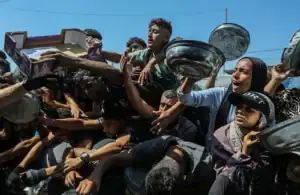
Between March and August 2025, humanitarian monitoring groups recorded 1,859 Palestinians were killed attempting to obtain food aid.[l] Of those, Israeli forces and contractors killed hundreds of others at or near the sites of aid distributions by the Gaza Humanitarian Foundation–which were at least in part designed by and continually coordinated through COGAT.[li]
On August 22, 2025, the IPC Famine Review Committee published its formal declaration, officially confirming Famine (IPC Phase 5) in the Gaza Governorate.[lii] The report documented that acute malnutrition rates among children under five exceeded 30%, crude mortality rates exceeded 2 deaths per 10,000 people per day, and starvation had become the primary driver of civilian mortality.[liii]
Leadership Transition and Continued Obstruction (Late 2025–2026)
When Major General Yoram Halevy assumed command of COGAT on February 4, 2026, he inherited a humanitarian landscape defined by engineered starvation and systematic destruction. Although the flow of humanitarian goods increased in the months since a partial ceasefire was reached in October 2025, and particularly since mid-2026, "the level of supplies entering the Gaza Strip remains significantly below the minimum agreed requirements of 600 trucks daily as per the terms of the Gaza Peace Plan."[liv] In July 2026, the IPC declared that famine had ended but that conditions remained in crisis levels.[lv] Adults in the Gaza Strip continued to reduce their own food intake to better feed their children, and the IPC expected 24,600 pregnant and breastfeeding women to suffer from acute malnutrition through April 2027. Combined with market forces shaped by Israel's restrictions on entry, children in particular have been unable to access healthy foods even though they are no longer suffering from acute malnutrition, according to UNICEF.[lvi] Israel continued to prevent 1.9 million people (90% of the population in Gaza) from returning to their homes, and has not allowed reconstruction to begin, which has meant that local food production has not resumed, and imports remained fragile and unpredictable.[lvii]
COGAT and the Israeli military have also imposed numerous restrictions that are preventing the resumption of domestic food production. At the start of the October 2025 ceasefire, 96 percent of cropland in Gaza was inaccessible and/or damaged.[lviii] By June 2026, eight months into the partial ceasefire and four months into Halevy's command of COGAT, Gaza's cropland became even more restricted, with 97 percent inaccessible and/or damaged.[lix] Further hampering the restart of domestic food production in Gaza, as of August 2026 COGAT was still restricting the import and distribution of essential agricultural inputs such as seeds, fertilizers, irrigation equipment, livestock feed and veterinary supplies.[lx] Prior to October 2023, according to the UN, agriculture supported the livelihoods of mor than 560,000—roughly one in four—people in Gaza.
Instead of immediately reversing the restrictions on the entry of critical goods to the Gaza Strip and allowing unrestricted aid access as mandated by the ICJ and set out in the ceasefire agreement, Halevy has maintained COGAT's arbitrary dual-use restrictions, tight border rationing, and cumbersome registration requirements for humanitarian organizations which has dramatically reduced the number of organizations importing and distributing aid in Gaza. Restrictions on dual use items such as engine oil and lubricants has continued to hamper the delivery of aid that is permitted to enter, as those oils and lubricants are necessary for maintaining fleets of trucks, as well as generators used for the production of electricity and the normal operation of hospitals.[lxi]
As the head of the Israeli army institution executing a policy of continuing to restrict aid to Gaza's civilian population, Alien and Halevy carried out grave violations of human rights.
Alien and Halevy's Legal Culpability
The legal culpability of Major General Ghassan Alian and Major General Yoram Halevy rests upon three evidentiary pillars: clear statutory mandate and operational control, the deployment of arbitrary administrative tactics to enforce starvation, and direct statements of intent.
Statutory and Operational Control
COGAT is legally vested with sole authority over civilian policy, border administration, and humanitarian logistics in the OPT.[lxii] COGAT's various officers and branches are responsible for creating and implementing regulations governing the movement of goods, including food, in and out of Gaza and are responsible for processing and approving—or denying—applications regarding the movement of goods, including basic humanitarian supplies like food.
According to current and former senior officers within COGAT, the unit's control over the movement of goods extends both to the entry of goods and also its movement within the Gaza Strip. "[COGAT] approves every single truck, and they decide what goes in and what stays out," Col. Sarhan, the former commander of COGAT's CLA for Gaza said in an interview with Israel's public broadcaster, Kan 11, in May 2026.[lxiii] One need not rely only on statements from former officials, however. Throughout the war, COGAT maintained a website publishing exactly how many trucks it approved to enter Gaza, and even notes certain periods when it blocked the entry of all aid.[lxiv] In an August 2025 webinar with the Friends of the IDF organization, Lt. Col. Yotam Shefer, head of COGAT's International Relations Branch, confirmed that the unit does "all the tactical coordination of all the aid that is being brought in and collected into Gaza."[lxv]
Procedures and protocols issued by COGAT have been outlined in a number of directives governing the Palestinian population residing in the West Bank and Gaza. This includes the authority to designate goods and items as "dual use."[lxvi]
COGAT's Mechanisms to Block, Restrict, and Hinder Aid
COGAT utilizes five distinct administrative procedures to restrict humanitarian aid entry into Gaza while maintaining formal compliance claims, both prior to and since the October 2025 ceasefire:
- Opaque Two-Stage Inspection Regimes
COGAT maintains a redundant screening regime requiring humanitarian items to receive advance clearance from COGAT headquarters, followed by physical inspection at Kerem Shalom or Nitzana. Even after obtaining advance written clearance, inspectors routinely turn back trucks at physical inspection points if inspectors discover a single item deemed non-compliant.[lxvii] The rejection of one item frequently results in the turning back of the entire truck or convoy, forcing re-packing and re-inspection cycles lasting weeks.
- Capricious and Unpredictable 'Dual-Use' Designations
COGAT maintains an overly-broad list of banned "dual-use" items, which includes many items that are vital to Gaza's civilian population. Among the items routinely rejected by COGAT inspectors are water purification tablets, solar-powered water pumps, medical X-ray machines, oxygen cylinders, surgical scalpels, mobile latrines, generators for hospitals, and pediatric nutrition kits.[lxviii] COGAT similarly rejects, without written justification, non-technical humanitarian items, including fresh meat, potato tubers, sleeping mats, and educational toys for children.[lxix] Since the October 2025 ceasefire, COGAT has regularly denied the entry of supplies like motor oil and other lubricants, which are critical for the distribution of food and other humanitarian items, the operation of hospital generators, and water pumping stations.[lxx]
- Bureaucratic and Politicized NGO Deregistration
In March 2025, COGAT introduced new operational regulations requiring international non-governmental organizations to undergo complex security re-certifications. The guidelines authorized blocking authorization to work on the ground to organizations deemed to have engaged in "delegitimization" of Israel – primarily groups that have published critical reporting on Israeli human rights abuses or starvation. Groups that Israel de-registered were stripped of their logistical entry permits, effectively shutting down major aid distribution networks.[lxxi] In July and August 2025 alone, Israeli authorities rejected requests from dozens of NGOs to bring in lifesaving goods, declaring that these organizations were "not authorized to deliver aid."[lxxii]
- Denial of Internal Movement Clearances
For aid convoys that manage to cross into Gaza, COGAT requires separate "internal coordination clearances" for every individual movement across internal checkpoints. UN OCHA data demonstrates that over the course of the war and through the current ceasefire, COGAT has consistently denied or delayed coordinated humanitarian movements inside Gaza. As recently as February 2026, OCHA reports that only half of humanitarian movements that require coordination with COGAT were fully facilitated.[lxxiii]
- Artificial Aid Entry Bottlenecks
COGAT has continued to restrict the daily operational hours of crossings into Gaza and limited the number of inspection lanes open at Kerem Shalom. Loaded trucks are forced to queue in long lines on the Egyptian side of the Rafah Crossing in extreme heat, causing perishable food supplies to spoil before inspection.[lxxiv] COGAT then used the resulting congestion to falsely claim to international media that aid was waiting on the border side due to "UN logistics failures." The quantities of food reported as offloaded or having arrived in Gaza, however, was and is subject to interception, looting, and unequal access to distribution sites, largely dependent on Israeli military facilitation, coordination, and approval.[lxxv] As discussed above, COGAT is responsible for all of those aspects of distribution and coordination.[lxxvi]
Direct Statements of Intent and Public Proclamations
The policy of collective punishment and starvation was publicly declared by senior Israeli military leadership. On October 10, 2023, Major General Ghassan Alian released an official video address in Arabic targeting the civilian population of Gaza. Standing in front of the camera in full military uniform, Alian explicitly stated:
"Human animals must be treated as such. There will be no electricity and no water [in Gaza], there will only be destruction. You wanted hell, you will get hell."[lxxvii]
This official statement directly links the complete denial of life-essential civilian infrastructure (water, electricity, basic provisions) to an intentional punitive strategy directed at the civilian population as a whole.
Starvation: Grave Violations of Human Rights, and War Crimes
The actions directed and executed by Maj. Gen. Ghassan Alian and Maj. Gen. Yoram Halevy, in particular to engineer mass starvation, constitute flagrant denials of the right to life and cruel, inhuman, or degrading treatment.
Violation of the Right to Life
Article 6 of the International Covenant on Civil and Political Rights (ICCPR), to which Israel is a State Party, guarantees that every human being has the inherent right to life. In General Comment No. 36 (2018), the UN Human Rights Committee explicitly clarified that the duty to protect life extends to addressing systemic threats to human survival, stating that States must take appropriate measures to address conditions in society that give rise to direct threats to life, including starvation, epidemic disease, and the deprivation of basic food, water, and shelter.[lxxviii] Furthermore, the right to life, enshrined in Article 11 of the International Covenant on Economic, Social and Cultural Rights, is inextricably tied to the right to food.[lxxix] International human rights law applies at all, including to Israel's conduct towards the occupied population, as the UN Human Rights Committee has repeatedly affirmed.[lxxx] By deliberately orchestrating an administrative system that deprived 2.1 million people of basic food and clean water that, which Human Rights Watch found likely resulted in the deaths of thousands of Palestinians[lxxxi], Alian and Halevy violated the right to life.
Cruel, Inhuman, or Degrading Treatment
Under the Convention Against Torture (CAT) and customary international human rights law, the deliberate use of starvation as a method of warfare and the obstruction of humanitarian aid are recognized as severe violations of the absolute prohibition against torture and cruel, inhuman, or degrading treatment.[lxxxii] When a warring party intentionally creates a state of severe deprivation or blocks external humanitarian operations, the resulting physical degradation provides tangible, actionable evidence of inhuman treatment.[lxxxiii] Consequently, international legal experts have argued that manipulating access to survival goods constitutes a direct assault on the physical integrity and inherent dignity of the person, qualifying as a prohibited form of cruel and inhuman treatment under customary and treaty-based international law.[lxxxiv]. CIDT is a non-derogable right under international law and applies unconditionally in times of armed conflict.[lxxxv] By intentionally creating severe deprivation, including through the obstruction of humanitarian aid, Alian and Halevy violated the absolute prohibition against torture.
Prohibition of Starvation under International Humanitarian Law (IHL):
Rules 53[lxxxvi] and 55[lxxxvii] of Customary IHL prohibit the use of starvation of civilians as a method of warfare and mandate that parties to a conflict must allow and facilitate rapid and unimpeded passage of humanitarian relief for civilians in need. Article 8(2)(b)(xxv) of the Rome Statute of the International Criminal Court codifies the intentional starvation of civilians by depriving them of objects indispensable to their survival—including willfully impeding relief supplies—as a grave war crime. [lxxxviii] "The most well-recognized starvation act is the weaponizing of humanitarian aid. This can be the restriction and blocking of humanitarian aid, or it can be using humanitarian aid as leverage for political negotiations or means to control local populations."[lxxxix] Although starvation as a method of warfare is primarily a war crime under IHL, "[s]tarvation crimes are pursued for diverse purposes, including control, collective punishment, ethnic cleansing, theft, and extermination,"[xc] many of which encompass and often occur concomitantly with the internationally recognized human rights discussed in previous sections. Because the crime of starvation has been applied by international jurists and others to the situation in Gaza, it is prudent, therefore, to include the crime of starvation under IHL in an assessment into whether there have been GVHRs.
Command Responsibility
Under both international law and U.S. legal frameworks governing Global Magnitsky designations, senior leaders are liable for serious human rights abuses committed by entities under their effective command and control.
The doctrine of command responsibility requires three core elements, all of which are satisfied regarding Alian and Halevy:
- Existence of a Command Relationship: Alian (2021–2026) and Halevy (2026–Present) held or hold formal operational command of COGAT. All CLA personnel, border inspectors, and civil liaison officers operated under their direct authority via a well-established hierarchy.
- Knowledge of Abuses: Both officers possessed actual and constructive knowledge that COGAT's restrictions were causing mass starvation and human deaths. The mass starvation had long been documented in public UN reports, IPC famine warnings, international judicial proceedings before the International Court of Justice, and direct diplomatic briefings from U.S. and European officials and were clearly known to Israeli military officials, as the New York Times reported in May 2025.[xci]
- Failure to Prevent, Halt, or Punish: Despite having full authority to modify inspection rules, expand operational hours, approve dual-use entries, and streamline INGO and humanitarian access, neither officer took steps to halt these violations. Instead, they defended the procedures, rejected international findings, and perpetuated restrictive policies.[xcii]
[i] https://www.timesofisrael.com/liveblog_entry/cogat-chief-addresses-gazans-you-wanted-hell-you-will-get-hell/
[ii] https://www.972mag.com/the-deadly-cost-of-israels-restrictions-on-foreign-doctors-in-gaza/
[iii] https://www.unocha.org/publications/report/occupied-palestinian-territory/gaza-humanitarian-response-update-22-december-2024-4-january-2025
[iv] https://edition.cnn.com/2024/03/01/middleeast/gaza-aid-israel-restrictions-investigation-intl-cmd
[v] https://www.theguardian.com/world/2025/may/20/israel-still-blocking-aid-for-gaza-despite-promise-to-lift-siege-says-un
[vi] https://www.who.int/news/item/22-08-2025-famine-confirmed-for-first-time-in-gaza
[vii] https://www.ipcinfo.org/fileadmin/user_upload/ipcinfo/docs/IPC_Famine_Review_Committee_Report_Gaza_Aug2025.pdf
[viii] https://www.unicef.org.au/stories/gaza-s-malnutrition-crisis?srsltid=AfmBOooGhtG8cnSWhAHTrSPwJP_r_85xEq2gII_TXwdEJlusS67-kJA7
[ix] https://www.who.int/publications/m/item/public-health-situation-analysis—occupied-palestinian-territory-September
[x] https://www.hrw.org/news/2024/12/19/israels-crime-extermination-acts-genocide-gaza
[xi][xi]
[xii] https://logcluster.org/en/documents/palestine-logistics-cluster-concept-operations-conops-july-2026
[xiii] https://www.ochaopt.org/content/reported-impact-snapshot-gaza-strip-9-september-2026
[xiv] https://logcluster.org/en/documents/palestine-logistics-cluster-concept-operations-conops-july-2026
[xv] https://www.unicef.org/sop/media/6801/file/Gaza%20Smart%20Survey%20-%20Executive%20Summary.pdf.pdf
[xvi] https://www.ochaopt.org/content/reported-impact-snapshot-gaza-strip-9-september-2026
[xvii] https://www.gov.uk/government/publications/global-human-rights-sanctions-guidance
[xviii] https://www.gov.uk/government/speeches/foreign-secretary-oral-statement-on-israel-palestine
[xix] "On September 19, 2007, the Ministerial National Security Committee declared Gaza a 'hostile territory' and instructed the security establishment to impose 'additional restrictions' in the civilian sphere, including with regard to the passage of goods, the supply of oil and electricity and the movement of persons to and from the Gaza Strip."
The Turkel Commission Report, January 2010, https://www.gov.il/BlobFolder/generalpage/downloads_eng1/en/ENG_turkel_eng_a.pdf
[xx] https://www.everycrsreport.com/reports/R41275.html
[xxi] https://www.gisha.org/UserFiles/File/publications/Bidul/bidul-infosheet-ENG.pdf
[xxii] https://carnegieendowment.org/sada/2021/11/the-bennett-governments-policy-towards-gaza
[xxiii] https://gisha.org/en/red-lines-presentation-released-after-3-5-year-legal-battle-israel-calculated-the-number-of-calories-it-would-allow-gaza-residents-to-consume/
[xxiv] https://gisha.org/en/red-lines-presentation-released-after-3-5-year-legal-battle-israel-calculated-the-number-of-calories-it-would-allow-gaza-residents-to-consume/
[xxv] https://gisha.org/en/red-lines-presentation-released-after-3-5-year-legal-battle-israel-calculated-the-number-of-calories-it-would-allow-gaza-residents-to-consume/
[xxvi] https://gisha.org/en/red-lines-presentation-released-after-3-5-year-legal-battle-israel-calculated-the-number-of-calories-it-would-allow-gaza-residents-to-consume/
[xxvii] https://www.kan.org.il/content/kan/kan-11/p-12043/s10/1042603
[xxviii] https://www.theguardian.com/world/2006/apr/16/israel
[xxix] https://www.kan.org.il/content/kan/kan-11/p-12043/s10/1042603
[xxx] https://www.ohchr.org/en/press-releases/2024/01/over-one-hundred-days-war-israel-destroying-gazas-food-system-and
[xxxi] https://www.reuters.com/world/middle-east/gaza-war-inflicts-catastrophic-damage-infrastructure-economy-2023-11-17/#:~:text=On%20average%20500%20trucks%20of,21https://www.fao.org/newsroom/detail/fao-sounds-alarm-over-high-risk-of-famine-across-the-whole-gaza-strip-amidst-humanitarian-access-constraints/en
[xxxii] https://www.timesofisrael.com/liveblog_entry/defense-minister-announces-complete-siege-of-gaza-no-power-food-or-fuel/
[xxxiii] https://d3jwam0i5codb7.cloudfront.net/wp-content/uploads/2024/03/Gaza-Report-Mar-2024-FINAL.pdf
[xxxiv] https://www.ipcinfo.org/fileadmin/user_upload/ipcinfo/docs/IPC_Famine_Review_Report_Gaza.pdf
[xxxv] https://www.ipcinfo.org/fileadmin/user_upload/ipcinfo/docs/IPC_Famine_Review_Report_Gaza.pdf
[xxxvi] https://www.ipcinfo.org/fileadmin/user_upload/ipcinfo/docs/IPC_Famine_Review_Report_Gaza.pdf
[xxxvii] https://www.ochaopt.org/content/hostilities-gaza-strip-and-israel-flash-update-48
[xxxviii] https://www.fao.org/newsroom/detail/fao-sounds-alarm-over-high-risk-of-famine-across-the-whole-gaza-strip-amidst-humanitarian-access-constraints/en
[xxxix] https://www.ipcinfo.org/fileadmin/user_upload/ipcinfo/docs/IPC_Famine_Review_Report_Gaza.pdf
[xl] https://www.ipcinfo.org/ipc-country-analysis/details-map/en/c/1156749/
[xli] https://wfpusa.org/news/gaza-conflict-timeline-aid-humanitarian-crisis/
[xlii] https://www.ohchr.org/en/press-releases/2024/01/over-one-hundred-days-war-israel-destroying-gazas-food-system-and
[xliii] https://www.pbs.org/newshour/politics/read-bidens-full-2024-state-of-the-union-remarks
[xliv] https://apnews.com/article/israel-palestinians-gaza-hamas-war-05-07-2024-113bf4ee5dad87dc5c003d76ed2785bf
[xlv] https://wfpusa.org/news/gaza-conflict-timeline-aid-humanitarian-crisis/
[xlvi] ttps://gaza-aid-data.gov.il/mainhome/
[xlvii] https://www.ipcinfo.org/fileadmin/user_upload/ipcinfo/docs/IPC_Famine_Review_Committee_Report_Gaza_Aug2025.pdf
[xlviii] https://www.ipcinfo.org/fileadmin/user_upload/ipcinfo/docs/IPC_Famine_Review_Committee_Report_Gaza_Aug2025.pdf
[xlix] https://www.ipcinfo.org/fileadmin/user_upload/ipcinfo/docs/IPC_Famine_Review_Committee_Report_Gaza_Aug2025.pdf
[l] https://www.ipcinfo.org/fileadmin/user_upload/ipcinfo/docs/IPC_Famine_Review_Committee_Report_Gaza_Aug2025.pdf; https://reliefweb.int/report/occupied-palestinian-territory/killings-palestinians-seeking-food-gaza-continue-starvation-deepens-enar
[li] https://www.nytimes.com/2025/05/24/world/middleeast/israel-gaza-aid-plan.html; https://www.hrw.org/news/2025/08/01/gaza-israeli-killings-of-palestinians-seeking-food-are-war-crimes
[lii] https://www.ipcinfo.org/fileadmin/user_upload/ipcinfo/docs/IPC_Famine_Review_Committee_Report_Gaza_Aug2025.pdf
[liii] https://www.ipcinfo.org/fileadmin/user_upload/ipcinfo/docs/IPC_Famine_Review_Committee_Report_Gaza_Aug2025.pdf
[liv] https://www.ipcinfo.org/fileadmin/user_upload/ipcinfo/docs/IPC_Gaza_Strip_Acute_Food_Insecurity_Apr_Dec2026_Special_Brief.pdf
[lv] https://apnews.com/article/gaza-food-insecurity-war-palestinian-israel-6570d65b767c7018e3929416ea475778
[lvi] https://www.haaretz.com/gaza/2026-08-27/ty-article/.premium/un-famine-has-ended-in-gaza-but-children-still-face-hunger-related-problems/000001a0-4255-d0d6-a3fc-46f5b92b0000
[lvii] https://www.ipcinfo.org/ipc-country-analysis/details-map/en/c/1165303/?iso3=PSE
[lviii] https://www.un.org/unispal/document/agricultural-land-15oct25/
[lix] https://www.un.org/unispal/wp-content/uploads/2026/08/ce1141en.pdf
[lx] https://www.un.org/unispal/document/fao-only-3-of-gazas-cropland-remains-accessible/
[lxi] https://www.reuters.com/business/energy/gazas-hospitals-homes-struggle-keep-generators-running-oil-shortages-bite-2026-09-10/
[lxii] https://features.gisha.org/trading-in-the-dark/
[lxiii] https://www.kan.org.il/content/kan/kan-11/p-12043/s10/1042603
[lxiv] https://gaza-aid-data.gov.il/mainhome/
[lxv] https://www.youtube.com/watch?v=5XjcdJoe_vE
[lxvi] https://gisha.org/UserFiles/File/B44.pdf
[lxvii] https://edition.cnn.com/2024/03/01/middleeast/gaza-aid-israel-restrictions-investigation-intl-cmd
[lxviii] https://www.washingtonpost.com/world/2024/04/11/israel-aid-gaza-banned-blocked/
[lxix] https://www.unocha.org/publications/report/occupied-palestinian-territory/gaza-humanitarian-response-update-22-december-2024-4-january-2025
[lxx] https://www.msf.org/israel-puts-thousands-risk-blocking-crucial-supplies-healthcare-gaza
[lxxi] https://www.oxfam.org/en/press-releases/israel-threatens-ban-major-aid-organizations-starvation-deepens
[lxxii] https://www.oxfam.org/en/press-releases/israel-threatens-ban-major-aid-organizations-starvation-deepens
[lxxiii] https://www.un.org/unispal/document/gaza-aid-missions-face-denials-and-delays-ocha-press-release/
[lxxiv] https://www.unocha.org/publications/report/occupied-palestinian-territory/gaza-humanitarian-response-update-17-30-august-2025; https://www.timesofisrael.com/heavy-scrutiny-and-regulations-block-tons-of-aid-from-entering-gaza-groups-claim/
[lxxv] https://www.ipcinfo.org/fileadmin/user_upload/ipcinfo/docs/IPC_Famine_Review_Committee_Report_Gaza_Aug2025.pdf
[lxxvi] https://www.youtube.com/watch?v=5XjcdJoe_vE
[lxxvii] https://www.timesofisrael.com/liveblog_entry/cogat-chief-addresses-gazans-you-wanted-hell-you-will-get-hell/
[lxxviii] https://docs.un.org/en/CCPR/C/GC/36
[lxxix] https://www.ohchr.org/en/instruments-mechanisms/instruments/international-covenant-economic-social-and-cultural-rights
[lxxx] https://www.un.org/unispal/document/auto-insert-180034/
[lxxxi] https://www.hrw.org/news/2024/12/19/israels-crime-extermination-acts-genocide-gaza
[lxxxii] https://pubmed.ncbi.nlm.nih.gov/41190545/; https://www.un.org/unispal/document/starving-civilians-in-gaza-is-lethal-inhumane-and-degrading-and-it-must-end-special-rapporteur-on-torture/; https://docs.un.org/en/A/79/171
[lxxxiii] https://www.cambridge.org/core/services/aop-cambridge-core/content/view/51C6FB49ACF6AC4841E50C3E50699639/S0021223722000024a.pdf/concomitant-prohibitions-collective-punishment-as-the-origin-of-other-violations-of-the-rights-of-civilians-under-belligerent-occupation.pdf
[lxxxiv]https://chicagounbound.uchicago.edu/cgi/viewcontent.cgi?article=1814&context=cjil
[lxxxv] https://doi.org/10.1093/jicj/mqn001
[lxxxvi] https://ihl-databases.icrc.org/en/customary-ihl/v1/rule53
[lxxxvii] https://ihl-databases.icrc.org/en/customary-ihl/v1/rule55
[lxxxviii] https://www.icc-cpi.int/sites/default/files/2024-05/Rome-Statute-eng.pdf
[lxxxix] https://docs.un.org/en/A/79/171
[xc] https://chicagounbound.uchicago.edu/cgi/viewcontent.cgi?article=1814&context=cjil
[xci] https://www.nytimes.com/2025/05/13/world/middleeast/gaza-famine-starvation-israel.html
[xcii] https://www.facebook.com/share/p/1B9AkKG6zu/; https://www.gov.il/BlobFolder/news/mfa-response-to-ipc-report-22-aug-2025/en/English_Swords_of_Iron_DOCUMENTS_COGAT_Humanitarian_Efforts_in_the_Gaza_Strip%E2%80%93Response_to_recent_IPC_publication-August_2025.pdf; https://www.israelhayom.com/2025/08/14/idf-israel-is-not-blocking-humanitarian-aid-to-gaza/
let's link to the presser here?