























DAWN Files Sanctions Referrals to Five Governments Against COGAT Chiefs
(Washington, D.C., September 24, 2026) – The former and current commanders of the Israeli army unit administering and implementing Israel's campaign of starvation against Palestinians in Gaza since October 7, 2023 should be sanctioned, said Democracy for the Arab World Now (DAWN) in filing formal sanctions referrals with the governments of the U.S., U.K., Canada, Norway and Australia today.
The submission calls on these governments to impose asset freezes and entry bans on Major General Ghassan Alian and Major General Yoram Halevy, the former and current head of the Coordinator of Government Activities in the Territories (COGAT).
Read more: Maj.-Gens. Ghassan Alian and Yoram Halevy Administered Campaign of Starvation in Gaza
In June 2025, the U.K., Canada, Norway and Australia sanctioned Israeli ministers Itamar Ben-Gvir and Bezalel Smotrich for inciting violence against Palestinians in the West Bank. Earlier this month, the U.K. announced that its sanctions regime would extend to serious violations of international humanitarian law "whether in Gaza or anywhere else in the world."
"Gaza was not starved by accident. A specific military unit was responsible for implementing and administering Israeli government directives to block and slow the entry of aid. The officials who ordered that starvation are wanted for war crimes and crimes against humanity; those who implement and continue to administer it should at minimum be sanctioned," said Omar Shakir, Executive Director at DAWN. "Some governments have developed sanctions programs targeting settler violence in the West Bank, but have not taken any action against the individuals responsible for Israel's mass starvation campaign in Gaza. The tools exist; all that is left is for governments to step up and use them."
The Coordinator of Government Activities in the Territories (COGAT), is the Israeli military unit that controls all movement in and out of Gaza and is responsible for approving and denying the entry of critical humanitarian aid, implementing Israeli government policies of total siege, and since October 2023, for approving and coordinating humanitarian movement within Gaza. Under their direct command authority, COGAT operated as the primary administrative instrument responsible for creating conditions of manufactured famine, extreme physical suffering, and widespread civilian mortality across Gaza.
On October 10, 2023, the day after then Israeli Defense Minister Yoav Galant ordered a complete siege on Gaza—for which he was indicted by the International Criminal Court in 2024 (those warrants did not include any military officers charged with implementing that policy)—Alian addressed Palestinians in Gaza in an Arabic-language video: "Human animals must be treated as such. There will be no electricity and no water, there will only be destruction. You wanted hell, you will get hell."
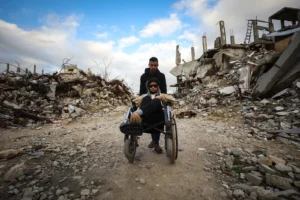
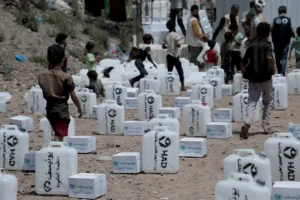
Since October 2023, the Israeli military, through COGAT, has imposed a blockade on Gaza and used starvation of civilians as a weapon of war. It has periodically imposed a total siege and, at other times, sweepingly restricted the entry of humanitarian aid by establishing an opaque, bureaucratic regime characterized by arbitrary rejections, changing clearance protocols, creating physical inspection bottlenecks, and interfering with internal aid distribution networks, creating mass starvation in Gaza.
Alian was the commander of COGAT until February 4, 2026, when he was replaced by Halevy. Despite an improvement since the ceasefire of October 2025, COGAT under Halevy's leadership has continued to restrict the entry of humanitarian aid. According to a July 2026 report by the UN Logistics Cluster, since the ceasefire, "[humanitarian] operations continue to be delayed or disrupted by bureaucratic access impediments […] the de-registration of several International NGOs, constantly changing administrative rules and restrictions on the entry of enabling equipment."
Dual-use restrictions, such as those on engine oil and lubricants, have made it more difficult for humanitarian organizations' and commercial actors to maintain trucks and distribute aid, and have worsened the electricity crisis in Gaza, with wide ranging consequences on the civilian population. In its latest food security survey from mid August 2026, the UN found that 21% of households in Gaza were subsisting on just one meal per day and a mere one in three children under the age of five were achieving minimum dietary diversity. In July 2026 alone, UN data shows that 3,000 children in Gaza were admitted for malnutrition treatment, including 380 with Severe Acute Malnutrition.
"COGAT's role in starving Gaza's civilian population is not in dispute–COGAT set out its own policy on video and has put in writing its restrictions for years," said Raed Jarrar, Director of Advocacy at DAWN. "Governments have everything they need to sanction COGAT officials. After today, none of them can say they were never asked."
The acts carried out by Alian and Halevy constitute Gross Violations of Human Rights (GVHR) under U.S. law—specifically the flagrant denial of the right to life and security of the person, and cruel, inhuman, or degrading treatment. In addition, starvation of civilians as a method of warfare and wilful impediment of relief supplies are prohibited by Article 54 of Additional Protocol I, by customary international humanitarian law and by Article 8(2)(b)(xxv) of the Rome Statute. The ICC's arrest warrants for Prime Minister Benjamin Netanyahu and former Defense Minister Yoav Gallant include starvation as a method of warfare but do not name the officers who executed the policy.
Separate from criminal responsibility, targeted sanctions, including asset freezes and travel bans, imposed on individuals are a key tool to stop ongoing abuses and deter future abuses. No Western government has yet designated or taken any concrete action against an Israeli officer for conduct in Gaza.
On September 8, 2026, UK Foreign Secretary Ed Miliband announced a package of measures on Palestine that includes strengthening the Global Human Rights Sanctions Regulations to target those who commit serious violations of international humanitarian law, a step his minister of state told the Commons would arrive within weeks. In the same statement, Miliband said that in Gaza, "life-saving humanitarian aid and access has been routinely blocked." Miliband need not wait for new sanctions regulations to designate Alian and Halevy; the UK's Global Human Rights Sanctions Regulations 2020 already allows the government to issue sanctions when they have "reasonable grounds to suspect" that a person is involved in, or is expected to soon be involved in, violations of the right to life or the prohibition on or cruel, inhuman or degrading treatment or punishment. Alian and Halevy are directly responsible for both.
Canada can issue sanctions under its Special Economic Measures Act, the instrument it used for the joint action regarding settler violence in the West Bank in June 2025. Australia can issue sanctions under the thematic human rights provisions of its Autonomous Sanctions Regulations. Norway can bar entry under immigration law and align with other sanctions, as they did with Ben-Gvir and Smotrich.
In the U.S., DAWN's submission asks the Treasury Department to designate both officers under Executive Order 13818, which implements the Global Magnitsky Act, and asks the State Department to bar them and their immediate families from entry under Section 7031(c) of the annual appropriations act, which covers foreign officials credibly implicated in gross violations of human rights. The letter also cites the State Department's failure to render COGAT ineligible for U.S. assistance under the Leahy Laws; the Department's failure to apply these laws to any Israeli unit is the subject of a legal challenge brought by Palestinians, supported by DAWN, currently being heard in the U.S. District Court for the District of Columbia.
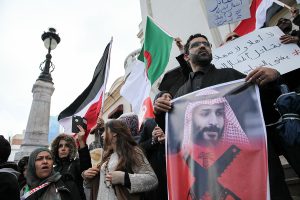
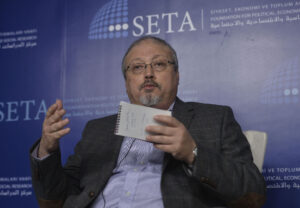
In a separate letter sent today to the chairs and ranking members of the Senate Foreign Relations and House Foreign Affairs Committees, DAWN called on Congress to invoke Section 1263(d) of the Global Magnitsky Act, which requires the President to determine within 120 days of a joint request from a committee's chair and ranking member whether a named person has committed sanctionable conduct, and to report to Congress whether sanctions will be imposed. In October 2018, the Senate Foreign Relations Committee's leaders invoked it over the murder of DAWN's founder, Jamal Khashoggi; Treasury sanctioned 17 Saudi officials within weeks, but the White House then let the 120-day deadline pass without the required determination on Crown Prince Mohammed bin Salman, asserting that the President retained discretion to ignore the request. A request on Alian and Halevy forces the administration either to answer or to repeat that refusal on the record.
Other states should also sanction and ban Alian and Halevy from entry. Netherlands, Belgium, Spain and France have barred Ben-Gvir or Smotrich from entry; Spain has already committed to barring anyone "participating directly in the genocide, the violation of human rights and war crimes in the Gaza Strip." Governments should also act to shield the ICC and its prosecutors and judges, as well as human rights defenders, from U.S. sanctions, which DAWN is challenging in federal court.
"Sanctions regimes exist to deal with situations of ongoing mass abuses like this, to make clear that human rights are non-negotiable and that following orders is never a defense for starving human beings or other grave crimes," said Michael Schaeffer Omer-Man, Israel-Palestine Director at DAWN. "The worst of the famine in Gaza may be over, but children are still starving, and taking action against Alian and Halevy can deter Israeli officials from continuing to keep the people of Gaza barely surviving."