























Maged Mandour is a political analyst and author of “Egypt Under El-Sisi: A Nation on the Edge.” He writes for multiple outlets and has made several media appearances as an expert on Egyptian politics and the Sisi regime.
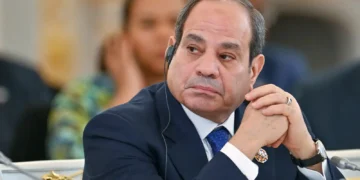
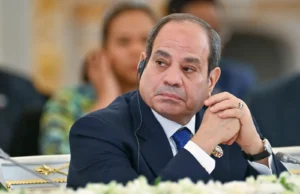
On Oct. 17, Egyptian President Abdel Fattah El-Sisi gave a speech confirming he will not run for office after his term ends in 2030. This announcement ends long-running speculation that the regime would amend the constitution, allowing the 71-year-old president to run in 2030 for another six-year term, after already doing so in 2019 to extend his rule. While many Egyptians would welcome the end of the Sisi era after suffering under his repressive rule, the proposed new process for becoming a presidential candidate reflects an Egyptian Armed Forces effort to tighten their grip on the state.
Coming to power in 2014 after leading a brutal military coup in 2013 that saw a harsh crackdown on Egyptian civil society, political parties and general civic engagement, Sisi has ruled the country with an iron fist. He has presided over the most brutal regime in Egypt's modern history, in which his government arbitrarily arrested, tortured, disappeared and wrongfully convicted those participating in any semblance of political opposition. Yet on the global stage, a regime that should have been universally condemned for its human rights abuses has received lavish support from the international community, from democracies and authoritarian states alike.
In his speech announcing the decision, Sisi outlined the proposed selection mechanism for presidential candidates. This process will seek PhD holders from Egyptian and foreign universities, aged between 40 and 50 years old, who will undergo a 30-month training program at the military academy. After passing the program, a panel will review their candidacy, with those accepted moving on to the presidential election.
While many Egyptians would welcome the end of the Sisi era after suffering under his repressive rule, the proposed new process for becoming a presidential candidate reflects an Egyptian Armed Forces effort to tighten their grip on the state.
- Maged Mandour
The new process represents a monumental shift, which, if it transpires, will further entrench the military as the undisputed hegemon of Egyptian politics, producing a significant degree of autocratic resilience the current regime does not possess. Departing from the personal power and charisma of Sisi and other strongmen in Egypt's political history will ultimately weaken the presidency's position relative to the military. That outcome is likely the point of the candidacy process.
Article 200 in the Egyptian constitution underpins candidate selection. Introduced by the amendments of 2019, the article anoints the military as the guardian of a secular state, the constitution and democratic and civil rights. It gives the military vast legal powers, often used to justify its interventions in Egyptian politics, including coups. It is important to note that there is no legal qualification for such intervention, and there is no other authority mentioned, like the president or the parliament, that is assigned the responsibility of approving such action. The military simply intervenes when it sees fit.
This philosophy is reflected in the vital role that the military will play in candidate vetting and selection, not only acting as gatekeepers, but also subjecting candidates to a 30-month indoctrination program before they are approved to run. The process leaves little doubt that whoever is selected will not pose a direct challenge to the military's political dominance and the model of debt-fueled, militarized state capitalism that has enriched its elites.
With Sisi's opposition decimated by years of repression, leaving no ruling party with widespread street support active in policymaking, the dysfunction of the Egyptian political system warrants attention. Effectively, this means that candidates for the program will most likely be technocrats, with no political organization to back their candidacy. Simply put, the new president will lack an organized political movement, democratic or otherwise, that can mobilize against the military's overt dominance.
As a result, the military may aim to weaken the presidency to dampen any risk that a new president can openly challenge the military's dominant position, let alone institute reforms that could affect its ability to appropriate public funds at will. In this regard, the military-led oligarchy will protect its interests at all costs.
The deep militarization of the state and economy in recent years likely fuels this thinking and will only worsen as a result, with any new president likely a mere placeholder figure. The armed forces' increasing dominance means it has no shortage of avenues to undermine a forthcoming presidency if it were to enact policies that negatively affect the military's position. Sisi's role as a supposed "savior" of the country from Islamist takeover and the power he enjoyed as a result of the initial wave of popular support when he came to power may not exist for future presidents.
Departing from the personal power and charisma of Sisi and other strongmen in Egypt's political history will ultimately weaken the presidency's position relative to the military. That outcome is likely the point of the candidacy process.
- Maged Mandour
Hence, Sisi's announcement and succession plans represent a process of authoritarian consolidation and, more disturbingly, deeper militarization. That ongoing process lives through the 2019 constitutional amendments, as the minister of defense can only be appointed after the approval of the Supreme Council of the Armed Forces (SCAF), the body representing the top brass and considered the highest military authority. The defense minister historically represents one of the main seats of power in Egyptian politics, effectively granting immunity to the head of the military.
In this context, the formula for long-term military rule has gradually become more institutionalized, entrenching its de jure power even further. The irony is not lost on those hoping for democracy to return to Egypt.
Still, these shifts do not necessarily negate the chance for a democratic opening, especially as an unintended consequence of these reforms. One of Sisi's most remarkable achievements, as Egyptian journalist Hossam el-Hamalawy notes, was to create a unity of purpose among the security establishment's different organs, ending turf wars and institutional overlap. That development took place because of shifting threat perceptions, with the 2011 Arab Spring drastically increasing fears in the military of a popular uprising. Traditionally, this intra-regime competition drove threat perceptions, as sociologist Hazem Kandil notes, with numerous coup attempts at various points throughout Egypt's modern history, specifically since the 1952 coup. In fact, Sisi was the latest iteration of this long-running precedent.
Whether Sisi's departure fosters a loss of unity and an increase in competition among military elites remains to be seen. Should such a development occur, an opening could appear that any political opposition can and should exploit.
Even with the stated reforms and relative loss of power to the military, the presidency could potentially remain quite constitutionally powerful, with vast legal authority still ultimately endowed in the office of the presidency. This power, however, can only be harnessed with an organized political movement or allies within the state apparatus backing the new president. Hence, instrumentalizing legitimacy to affect reforms, if popular backing exists and if the cost of repression is deemed too high by the military and security apparatus, constitutes one possible scenario. Such a development hinges, however, on the ability of any would-be opposition to create an organized political movement with a popular program that can challenge military dominance and push the presidency or, at minimum, be embraced by it. It is certainly a tall order, but not implausible.
For now, one fact is clear: For the first time since 2013, the president and the military will have daylight between them, creating an opening the opposition can exploit. In essence, inadvertent democratization could appear, perhaps in the case of an ageing dictator forced to pick a successor. This thesis, however, is optimistic, requiring immense efforts to create any opening that can repair the colossal damage Sisi has inflicted on the Egyptian economy, state, society and political system. The more likely scenario, however, is deeper militarization and deeper authoritarian consolidation, significantly increasing the resilience and, arguably, the longevity of the regime.
The views and positions expressed in this article are those of the author(s) and do not necessarily reflect the views of DAWN.