











Commemoration and Protest in DC Planned to Mark Anniversary
(Washington, D.C., October 1, 2026) — Congress should pass three pending resolutions blocking arms sales and a nuclear cooperation agreement with Saudi Arabia, DAWN said today, marking the eighth anniversary of the killing of its founder, Jamal Khashoggi.
Pending resolutions in the House and Senate would block a $5 billion bomb sale, a $24.3 billion sale of F-35 fighter jets and a nuclear cooperation agreement with Saudi Arabia.
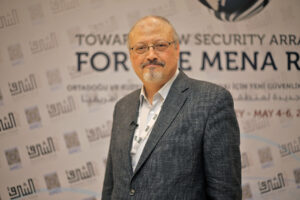
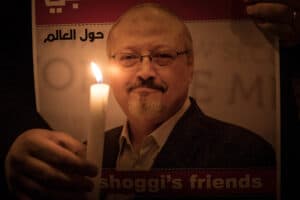
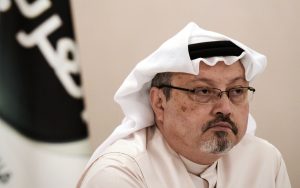
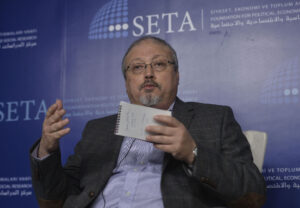
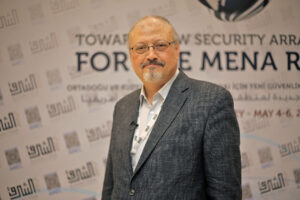
On October 2, 2018, a Saudi hit team murdered and dismembered Jamal Khashoggi inside the kingdom's consulate in Istanbul, in an operation the U.S. intelligence community concluded was "approved" by Crown Prince Mohammed bin Salman. Not only has Bin Salman not been charged for killing Khashoggi or sanctioned for ongoing repression, but Trump, when asked in November 2025 about the murder with the Crown Prince at his side, said "things happen."
"For Trump to dismiss a Saudi hit team killing and dismembering a respected dissident and Washington Post columnist at a Saudi consulate as a thing that 'happens' in the presence of the person American intelligence said approved the operation underscores ongoing deep U.S. complicity in repression in Saudi Arabia and across the region," said Omar Shakir, Executive Director at DAWN. "More than eight years after the heinous killing of Jamal Khashoggi, Trump's words are a flashing green light for every autocrat friend of the U.S. with a critic abroad."
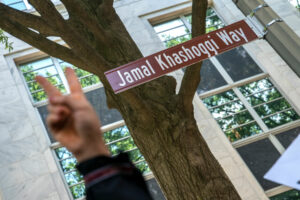
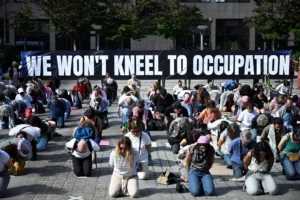
DAWN will mark the anniversary on Friday, October 2, at 5 p.m. with a protest outside the main entrance of the Saudi Embassy at 600 Jamal Khashoggi Way NW, co-hosted with the Arab Rights and Research Center. On Monday, October 5, at 6 p.m., DAWN will hold its annual gala and awards dinner in memory of Khashoggi at the National Press Club under the banner "Ending Complicity. Fighting Impunity."
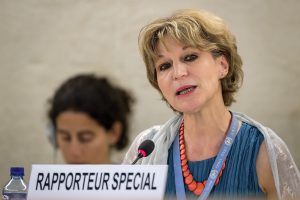
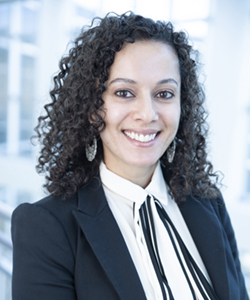
U.S. Senator Chris Van Hollen, a leading voice in the effort to end U.S. support for repressive regimes in the MENA region, will deliver the keynote at the gala. The gala will honor Dr. Tanya Haj-Hassan, the Jordanian-American pediatrician whose testimony from medical missions in Gaza has drawn attention to the devastating toll on Palestinian children and health care workers, and Ahmed Shihab-Eldin, the Emmy-nominated journalist whom Kuwait detained for nearly two months this year over his journalism and subsequently stripped of his Kuwaiti citizenship. Dr. Thaer Ahmad, featured in the documentary American Doctor, Nobel laureate Tawakkol Karman, UN Special Rapporteur Francesca Albanese, journalist and Middle East editor at Drop Site News Sharif Abdel Kouddous, and DAWN staff and board members will also speak at the gala.
On November 18, 2025, while hosting the crown prince at the White House for his first visit since Khashoggi's murder, President Trump, when asked about Khashoggi, replied that "a lot of people didn't like that gentleman," that "things happen," and that the crown prince "knew nothing about it," then rebuked the reporter for embarrassing his guest. A 2021 assessment by the Office of the Director of National Intelligence found that the crown prince had absolute control over the kingdom's security and intelligence organizations, making it highly unlikely the operation was carried out without his authorization. The day that assessment was released, in February 2021, the State Department announced the "Khashoggi Ban," a visa restriction policy applied to 76 Saudis involved in targeting dissidents abroad, but not to the man who ordered the killing. The pattern is not new. In October 2018, the leaders of the Senate Foreign Relations Committee invoked the Global Magnitsky Act to require a presidential determination on the crown prince's responsibility within 120 days; the first Trump administration never made the required determination, asserting that the President could decline the request.
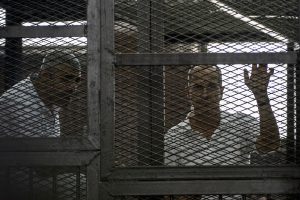
The second Trump administration has gone from shielding the crown prince to rewarding him. On September 4, the State Department notified Congress of a $5 billion sale of 10,000 guided-bomb kits to Saudi Arabia, including 5,000 for 2,000-pound BLU-117 bombs. Two weeks later it approved a $24.3 billion sale of 48 F-35 fighter jets, the first ever sale of the aircraft to the kingdom. These arms sales came just after the administration transmitted to Congress in late August a 30-year civil nuclear cooperation agreement without traditional safeguards it has used in other agreements. The Saudi government is receiving these perks, despite executing at least 356 people in 2025, a record high for the country surpassing the 345 people they executed in 2024. One of those executed last year was journalist Turki al-Jasser, who was sentenced to death over his writing.
On September 16, Senators Ed Markey, Jeff Merkley and Bernie Sanders introduced S.J.Res.216, a joint resolution of disapproval of the bomb sale under the Arms Export Control Act. Such resolutions receive expedited treatment in the Senate: if the Foreign Relations Committee does not report the resolution within ten calendar days of introduction, any senator can force a floor vote. In the House, a resolution is guaranteed a vote only if the Foreign Affairs Committee reports it, so the committee's leadership must act. On September 16, Representatives Gregory Meeks, Brad Sherman, John Garamendi and Don Beyer also introduced H.J.Res.217 a joint resolution of disapproval on the nuclear agreement. Under the Atomic Energy Act's 90-day review process, the relevant committees have 45 days to report it, after which it is automatically discharged and sent to full congress for a vote; it then moves under expedited procedures in the Senate, while in the House it depends on the Rules Committee bringing it to the floor. On September 24, Senator Rand Paul introduced S.J.Res.217 against the F-35 sale; separately, a bipartisan group of eighteen senators has asked the administration to release the nuclear agreement's classified side letters. A vote on the three resolutions are expected after the November elections, and would need two-thirds of both chambers to survive a veto.
In a letter sent to all members of Congress today, DAWN called for co-sponsoring and passing these three resolutions, S.J.Res.216, S.J.Res.217 and H.J.Res.217, and on House members to introduce companions to the two Senate arms sale resolutions and on the Foreign Affairs Committee to report them so they can reach the floor.
"The killing of Jamal Khashoggi is not just a memory– it is unfinished business. Human rights advocates will take to the streets in D.C. Friday and to the National Press Club on Monday to continue the fight for justice," said Raed Jarrar, Advocacy Director at DAWN. "There is no reality where offering MBS bombs, jets and reactors advances human rights and prosperity in the MENA region. Members of Congress should urgently act to put a stop to ongoing U.S. complicity in Saudi repression."
For more information on the DAWN gala and to purchase tickets (today is the last day to do so): https://dawnmena.org/dawn-2026-annual-gala-awards-dinner/