








Kourosh Ziabari is a journalist and media studies researcher based in New York. A contributor to New Lines Magazine, he is an alumnus of the East-West Center’s Senior Journalists Seminar Fellowship and a 2022 World Press Institute fellow with the University of St. Thomas, Minnesota. Ziabari has covered the United Nations on a Dag Hammarskjold Fund for Journalists fellowship. His writings have appeared in Foreign Policy, Politico, The American Conservative, openDemocracy and Truthout, among others. He has earned a master’s in political journalism from Columbia Journalism School. Follow him on X (Twitter).
When the United States and Israel launched surprise airstrikes on Iran in February, one of the most unexpected reactions came from the European Union. Despite its track record of opposing unilateral military campaigns and espousing peace, the bloc of 27 nations refused to denounce the war of aggression against a United Nations member state, which many legal experts warn violated the U.N. Charter. That indecision has called Europe's moral authority into question during a moment of global unease.
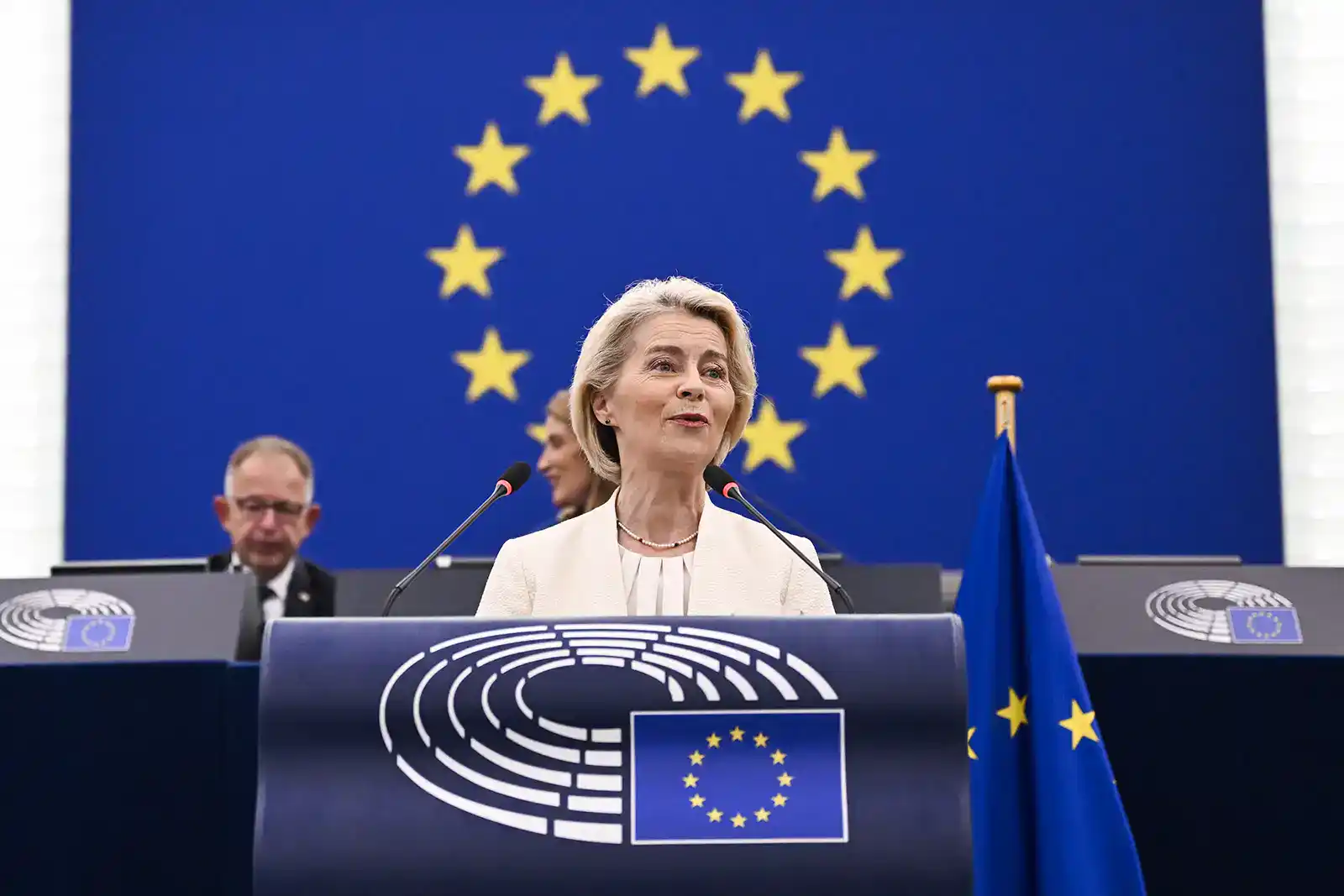
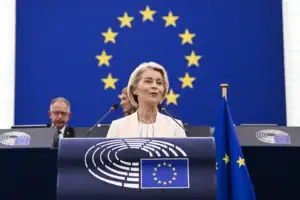
In their first statements after the war, top European officials echoed a mix of contentment and retribution. President of the European Commission Ursula von der Leyen gave a scathing speech on March 10, criticizing Iran's negative regional role, insisting that Tehran's past wrongdoings, and not the ongoing aggression against it, should be the point of focus. "Earlier this year, hundreds of thousands of young Iranians took to the streets to demand a better future," she said.
"They were met with brutal repression. More than 17,000 were killed as the regime clung to power," she added. "But the crimes of this regime go back decades … There should be no tears shed for such a regime."
At that point in the war, the Pentagon had already opened an investigation into the U.S. bombing of an elementary school in Minab, killing over 150 civilians, including 120 Iranian children. Von der Leyen conveniently skipped that tragedy in her speech, like many other European leaders who ignored the massacre.
Outside the small club of leaders refusing to endorse the war under pressure from the White House, Members of the European Parliament (MEPs) have been the most vocal European opponents of the war.
- Kourosh Ziabari
President of the European Parliament Roberta Metsola said in the assembly's first plenary debate after the war began that Iran had long posed a threat to regional security and had oppressed Iranian citizens. She also avoided commenting on the legal basis of the war. Many EU officials shared views along similar lines: The Iranian government was responsible for human rights violations and funded militant proxies, justifying war as an opportunity for Iranians to topple their theocracy. Beyond any previous point, the law-abiding, consensus-oriented Europe was undiplomatic in its nod of approval to a war of choice.
Months later, however, the war still rages amid limited democratic prospects. Instead, Iranian citizens have suffered under foreign violence heaped atop the clerical establishment's repressive structure. With the EU backing efforts to rekindle the debate on Iran's nuclear program at the U.N. Security Council (UNSC) following a vote by the International Atomic Energy Agency earlier in September to further strangle the country, the major powers' Iran playbook appears unchanged.
Some European states have actively facilitated the escalation of hostilities. At various stages of the war, several EU member states, including Bulgaria, France, Greece, and Italy, gave U.S. forces access to bases on their soil for military operations against Iran. Similar details have emerged regarding the United Kingdom's cooperation with the United States and Israel, although it is no longer a EU member.
Among sitting European leaders, it was only Spanish Prime Minister Pedro Sánchez who publicly spoke out against the war. He was later joined by the Slovenian President Nataša Pirc Musar, who on April 9 said that there must be "zero tolerance" for genocidal rhetoric pledging to end "a whole civilization," referencing Trump's early April threat against Iran. They both earned plaudits globally for their moral clarity and rejection of militarism.
Outside the small club of leaders refusing to endorse the war under pressure from the White House, Members of the European Parliament (MEPs) have been the most vocal European opponents of the war, criticizing the military campaign on ethical grounds. Although MEPs' influence is limited in decision-making processes, their criticism of the EU's double standards and its indifference to the war's civilian costs speaks truth to power amid a universal crisis of moral authority.
These MEPs have lamented the EU's inability to coordinate a cohesive response to the unauthorized military campaign against Iran, pointing to the bloc's role in the gradual collapse of international law.
Matjaž Nemec, a Slovenian MEP from the Party of European Socialists (PES) and assistant to former President of Slovenia Borut Pahor, told Democracy in Exile that what concerns him is not only the scale of human suffering caused by the war but Europe's response to it.
"Silence or ambiguity creates the impression that some lives matter less than others," he said. "It exposes the hypocrisy and the double standards we have when it comes to Russia, for example, [and on] Israel and the USA, on the other hand."
"That is something I cannot accept," he added.
Retired politicians have also challenged the dominant pattern of complacency shown by most EU leaders. Former French Prime Minister Dominique de Villepin was one of a handful of senior European politicians to call for sanctions against Israel. As a legal response to Tel Aviv's violations of international law, experts have recommended sanctions before. In most European capitals, however, leaders continue to treat the idea as taboo, despite applying these measures to other countries like Russia after its invasion of Ukraine.
"Any country that engages in an illegitimate, illegal intervention must pay the price for rebuilding what it has destroyed. You destroy, you repair," de Villepin said in an interview with the French broadcaster BFM TV in March. He proposed the establishment of a U.N.-monitored mechanism for reparations, similar to the arrangement that the U.N. General Assembly voted to establish in November 2022 for Ukraine.
Of the few European elders who have condemned the war, former British Prime Minister Gordon Brown stood out as a critical voice. Currently serving as the U.N. Special Envoy for Global Education, Brown published a searing March 12 critique of the bombing of Minab's Shajareh Tayyebeh school in The Guardian, where he argued the attack had "shaken to its very core the conscience of the world."
"[R]egardless of where they operate or under whose orders they act, there will be no hiding place for those leaders who permit attacks on children," he concluded.
It is reported that 38 children were killed in the deadly Oct. 7, 2023, attacks on Israel, which different EU bodies unanimously condemned. With nearly three times that number of children perishing in the U.S. strikes on the school in Minab with two Tomahawk missiles, Europe's hesitation to react remains a mystery.
Leading human rights organizations like Amnesty International have confirmed U.S. responsibility, even as the U.S. government appears to be stalling the release of its investigation. A U.N. fact-finding mission similarly found "reasonable grounds" to believe the U.S. military committed a war crime by striking the elementary school.
During the first 39 days of the war, briefly paused with a now-collapsed ceasefire agreement, American and Israeli strikes damaged or destroyed 125,000 civilian buildings, according to the Iranian Red Crescent Society. At least 3,500 casualties have been reported in Iran.
Although MEPs' influence is limited in decision-making processes, their criticism of the EU's double standards and its indifference to the war's civilian costs speaks truth to power amid a universal crisis of moral authority.
- Kourosh Ziabari
A far cry from only targeting nuclear or military sites, these attacks have damaged or destroyed 140 cultural monuments in Iran, five UNESCO World Heritage Sites, major universities, a 100-year-old pharmaceutical company co-founded by the Paris-based Institut Pasteur, houses of worship of religious minorities, sports stadiums, transportation bridges and desalination plants. The willingness, if not intent, to strike civilian locations on such a wide scale should warrant critical scrutiny from an institution founded as a force for the rule of law, yet for the European Union and most of its members, the opposite has been true.
MEPs who recalled Europe's collective action after Russia's invasion of Ukraine in February 2022, including endorsing 21 packages of sanctions against Moscow and freezing the assets of Russian President Vladimir Putin, see this display of indifference to the U.S.-Israel war against Iran as an integrity problem for the European institutions.
"As a European citizen and a member of the European Parliament, I am deeply ashamed of the hypocrisy of a European Union and its parliament that proclaims its commitment to the principles of the United Nations Charter while failing to condemn the U.S.-Israeli attack on Iran as a grave violation of that very Charter," said Michael von der Schulenburg, a MEP from Germany's Reason and Justice party (BSW), in an interview with Democracy in Exile.
"This attack occurred during ongoing and constructive negotiations and began with an opportunistic and devious 'decapitation' strike aimed at eliminating Iran's political and military leadership," he said.
"One must look back to the Middle Ages to find similarly treacherous examples in which peace negotiations were exploited as a pretext to destroy the leadership of the opposing side," he added. "This is a war crime of historical proportion."
Von der Schulenburg, who had previously served as an assistant Secretary-General of the United Nations, believes the European Union is not simply confronting a credibility crisis: "Failing to condemn the war crime[s] committed against Iran, and likewise the war crimes committed in Gaza, the West Bank and Lebanon, goes far beyond a mere loss of credibility." For him, the West, including the EU, is "progressively dismantling the very international order it once built."
Hana Jalloul Muro, vice-president of Socialist International and a lecturer in international terrorism, detailed her views about the unlawfulness of the war in an essay for the Foundation for European Progressive Studies, describing "no to war" as "more than a Spanish slogan."
"I have condemned and continue to firmly condemn the unilateral and unlawful military attack carried out by Israel and the United States against Iran," the Spanish MEP told Democracy in Exile. "The death of innocent civilians and of children in their schools is inconceivable, and the European Union must take it seriously, just as we have condemned Iran's attacks on the Gulf states."
"One of the main concerns we have recently denounced is the Commission's double standards, particularly when comparing the European Union's response to the Russian invasion of Ukraine and the ensuing war with its response to the genocide in Gaza," she said.
"For months, I have received emails from thousands of citizens across every member state asking that the EU do something, take on a role and act, because what was happening in Gaza hurts them just as deeply as it hurts us," she added.
Jalloul, a member of the Spanish Socialist Workers' Party (PSOE) led by Sanchez, told Democracy in Exile her party has also deplored the fact that the EU has not been compliant with international law in condemning "attacks against innocent people carried out by two states that lack the authorization of the United Nations Security Council." She said condemning the war would be "perfectly compatible" with criticizing the violence of the Iranian government and its human rights record.
The socialists of the European Parliament are not alone in opposing the war. Those aligning with nationalist parties and lawmakers with no formal party affiliation have also been skeptical of the EU's lack of a common anti-war position in line with its previous humanitarian gestures.
"I think that human rights are often merely treated as an instrument to justify wars or violent regime change but [are] ignored when other interests are at stake," said Fabio De Masi, a former member of Germany's Bundestag, who is currently a non-attached member at the European Parliament. Also known as non-inscrits (NI), the non-attached members do not belong to any of the eight political groups of the European Parliament.
"Trump did not bomb Iran, including a girls' school, to defend women's rights," De Masi told Democracy in Exile. "The EU might disguise its dependency on the U.S. and its geopolitical agenda by portraying itself as a benevolent power anchored in multilateralism and the defense of human rights. However, that is largely window dressing."
He believes the lack of a principled response to geopolitical crises will undermine the EU's credibility among Global South nations who did not sympathize with Ukraine after Russia attacked that country, arguing, "The rhetoric by EU leaders around human rights is driven by geopolitical ties."
As the MEPs who talked to Democracy in Exile noted, anti-war sentiments in Europe have been dominant, though they have not fostered major protest movements. An April poll conducted by Polling Europe/Euroscope found that an overwhelming majority of Europeans view the war on Iran as unjustified, including 72% of Italians and 69% of Spaniards.
Yet as the war continues, with a widening impact on communities worldwide, far too many European leaders appear hard-pressed to develop initiatives that break the deadlock, particularly out of fear of losing already unreliable support on Ukraine from Washington.
These dynamics expose what seems to have blocked Europe from emerging as a morally responsible actor in the middle of a period of global uncertainty. While MEPs and some individual leaders have called for the rule of law to be respected, European institutions have failed to stand up for human rights collectively at this time of urgency. The result is a world haunted by unnecessary conflicts, with the assault on Iran at the epicenter.
The views and positions expressed in this article are those of the author(s) and do not necessarily reflect the views of DAWN.