



Yahia Lababidi is an Arab-American writer of Palestinian heritage and the author of sixteen books of poetry and prose, including Palestine Wail (2024). His latest, If You Cannot Say GENOCIDE: Essays on Conscience and Witness (New Village Press, 2026), received a starred review from Publishers Weekly and was named by The New Arab among ten essential books on Gaza. His writing has appeared in +972 Magazine, The New Statesman, Liberties, and Common Dreams, among other publications.
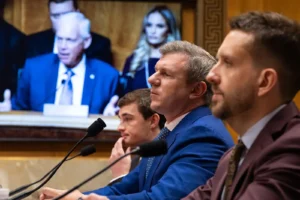
On Minnesota's primary day in August, a man in a black veil entered a Minneapolis polling station accompanied by another wearing traditional Muslim clothing and speaking in an exaggerated accent. A hidden camera recorded the encounter. The veiled man was Cam Higby, a conservative online personality. His companion was James O'Keefe, founder of O'Keefe Media Group and formerly of Project Veritas, who introduced their performance as "vouching for seven other Muslims at a Minneapolis polling booth." Before anyone inside the polling station said a word, the disguises had supplied the suggestion of fraud.
In the weeks that followed, the men circulated their recordings as proof of dangerous weaknesses in Minnesota's election law. On Oct. 28, the Hennepin County Attorney's Office charged both with felony unlawful voting and identity theft. According to prosecutors, they gave polling officials the names of registered voters without permission. Some names belonged to people who were dead.
Neither man cast a ballot nor signed a voting oath. Both deny having broken the law. O'Keefe maintains that his activities constituted legitimate investigative journalism, intended to expose electoral vulnerabilities. The charges will be tested in court, but the costumes merit attention in their own right.
The target was Minnesota's system of "vouching," which has existed since 1973. A registered voter may attest, under oath, that another eligible voter lives in the same precinct, allowing that person to establish residence for same-day registration. The applicant must supply identifying information for verification. Such arrangements are useful to people who have moved recently, including elderly residents of nursing homes.
Trump and the American right have long reserved the ugliest language for Muslim Americans, among them Omar, whose citizenship and loyalty he has repeatedly questioned for years.
- Yahia Lababidi
In the 2024 general election, fewer than six in a thousand Minnesota voters used vouching, and some 71% of them were simply updating an existing registration. The election workers in the videos explained the procedure. They also reported the suspicious encounters, setting in motion the investigation that produced the charges.
I remain curious about the disguises. Why dress as Muslims and affect a foreign accent in the first place? O'Keefe could have tested the law dressed as himself; the rules would have remained the same. Indeed, his production relied on a more ancient reflex: an unfamiliar Muslim face, or a face deliberately concealed, invites mistrust. The clothing was part of the accusation.
Another participant in the broader effort, Anthony Rubin of Muckraker, took two men dressed in Muslim clothing to a polling station and told workers they were Hamas members who had recently come from Gaza. He asked about vouching for them, acknowledging he did not know their citizenship status. The video offered the reassuring simplicity of a nightmare: terrorists from Gaza could stroll into an American election and have their votes accepted. In fact, falsely claiming residence or eligibility would expose both a dishonest voucher and an ineligible applicant to criminal penalties.
Rubin declined a request from Votebeat to release his unedited footage. No Hamas voter was produced. Gaza had been recruited for an American political fantasy.
O'Keefe had previously targeted Minnesota's Somali community. In 2020, Project Veritas aired allegations of ballot fraud implicating associates of Representative Ilhan Omar. A local FOX 9 investigation found scant evidence for the claims, noting that some activities portrayed as wrongdoing might have been lawful.
Six years later, Somali Americans are once again cast as the faces of a supposed electoral conspiracy. Minnesota is home to one of the country's largest Somali communities, yet in this peculiar theatre, its members have been reduced to an accusation waiting for a witness.
The president has helped furnish the atmosphere in which such performances flourish. On Oct. 8, Donald Trump announced that Minnesota was being "taken over by Somali Immigrants," urging its people to "fight back." That same day, he attacked Abdul El-Sayed, the Muslim Democratic Senate candidate in Michigan, as a radical extremist and terrorist sympathizer. El-Sayed won his campaign on Nov. 3 anyway, becoming the first Muslim elected to the U.S. Senate.
Trump and the American right have long reserved the ugliest language for Muslim Americans, among them Omar, whose citizenship and loyalty he has repeatedly questioned for years. Last December, he called Somali Minnesotans "garbage." Strange, how easily suspicion can be made to pass for patriotism.
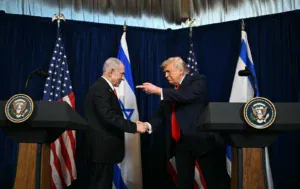
Ten days after his tirade against Minnesota's Somalis, Trump offered his "Complete and Total Endorsement" to Israeli Prime Minister Benjamin Netanyahu, informing Israelis that anyone other than "Bibi" would be the wrong leader. The beneficiary of this blessing faces an outstanding International Criminal Court warrant over war crimes and crimes against humanity in Gaza, alongside a corruption trial within Israel. He also leads a political movement adopting the hallmark traits of America's far-right.
The Israeli election's count left his bloc with 53 seats in the 120-member Knesset, against 48 for the principal opposition bloc led by Gadi Eisenkot. The Arab-led Joint List and Ra'am, meanwhile, won a historic 19 seats. Nearly 840,000 people voted for the two lists, a 64% increase from 2022. Palestinian citizens of Israel, whose political participation has often been discouraged by disillusionment, turned out in remarkable numbers. As the count proceeded, Netanyahu's Likud party announced that Arab parties had "stolen" the election through bribery and manipulated votes.
The video offered the reassuring simplicity of a nightmare: terrorists from Gaza could stroll into an American election and have their votes accepted. In fact, falsely claiming residence or eligibility would expose both a dishonest voucher and an ineligible applicant to criminal penalties.
- Yahia Lababidi
Israeli police reported no evidence supporting claims of widespread fraud. The acting director of the Central Elections Committee likewise rejected allegations of systematic violations. Separately, the Shin Bet, Israel's internal security and counterintelligence agency, is examining suspicions of improper foreign funding. On Oct. 29, the agency cautioned that its unfinished inquiry should not cast suspicion on Arabs as a whole. Within a week, it warned of foreign funding affecting thousands of people, though it presented no evidence.
The allegations remain unproven. While Likud nevertheless sought to delay certification, the Central Elections Committee certified the results on Nov. 4. Its chairman, Justice Noam Sohlberg, said that suspected irregularities were still under investigation, but that available evidence did not call the results as a whole into question.
Now, Likud warns against the "Islamization of Israel," declaring that no Zionist party should govern with the Arab factions. There, in the ruling party's own words, was the same fear that the Minneapolis disguises had been contrived to summon.
That refusal and mindset extends into key components of the opposition. On Nov. 5, following consultations with President Isaac Herzog, parties representing 67 members of the Knesset recommended Gadi Eisenkot to form a government, against 46 for Netanyahu. The additional 19 recommendations for Eisenkot came from Ra'am and the Joint List. The Joint List said its unanimous decision was made in response to the public demand to prevent Netanyahu and his government from holding power.
The limits of this support were evident during Herzog's consultations. Mansour Abbas, the leader of Ra'am, was pressed to declare Hamas a terrorist organization. Abbas condemned violence and called for Hamas and other armed groups to disarm, but declined the requested designation, citing his mediation work and his family's safety. He objected to being subjected, yet again, to a "loyalty test." Yet Eisenkot made recognition of Hamas as a terrorist organization a condition for parties seeking to join his government. Abbas recommended him nonetheless.
Netanyahu later warned that a government dependent on Arab parties threatened Israel's "very survival." Among those seeking to replace him, resistance took a different form. On Nov. 6, Avigdor Liberman, whose party recommended Eisenkot, said he was prepared to compromise on military conscription with ultra-Orthodox parties if a coalition excluded the Arab parties, as he remains opposed to any government dependent on those Arab parties. Now, Eisenkot may seriously be considering this path.
The resemblance between these electoral dramas deserves attention, though their circumstances differ. O'Keefe is an activist facing criminal charges. Netanyahu is a prime minister confronting an electoral setback. No evidence suggests their activities were coordinated. Yet the willingness on the part of far-right movements across the globe to target minorities and, specifically, Arabs and Muslims to push their agendas is not new.
It is, however, expanding. In this case, both instances appealed to the suspicion that Muslim and Arab participation in democratic life requires extraordinary explanations. Such bias, once granted the dignity of a conviction, has a habit of outliving its evidence.
On Nov. 3, CBS Minnesota reported a large turnout at a polling station in Cedar-Riverside, a Minneapolis neighborhood with a large Somali community. Faduma Abdi, 40, a nursing-home worker and mother of three who lives in Cedar-Riverside, told the Minnesota Reformer that she had previously voted to fulfill her civic duty, but this time she voted to fight back against Trump. "Trump targeted us, and now we have the opportunity to fight back," she said. "He called us 'garbage.' And that's not acceptable." There was no disguise in this scene, nor any mystery about why people had come.
Yet for a truly global far-right that has mainstreamed Islamophobia and ethnic and racial supremacy, the mere recognition of Arabs and Muslims in places like Israel and the United States goes too far. This sad reality makes clear their exclusionary politics, one hell-bent on using lies and fear to keep political power and advance their crimes. Yet when the "wrong" people vote, they push back, advancing an inclusive politics and true democracy. Whether those efforts succeed will play a crucial role in both countries moving forward.
In Minneapolis, election workers followed the law and reported strangers who had appeared before them under borrowed names. In Israel, Palestinian citizens cast ballots for Ra'am and the Joint List, only to hear the ruling party denounce their votes as stolen. Their 19 lawmakers have since helped put Eisenkot ahead of Netanyahu in the contest to form a government on Nov. 8. Some of his prospective partners insist those parties must play no part in sustaining any government he forms. In doing so, major political forces in both countries make clear a simple fact: When the wrong people vote, suspicion, vilification and exclusion represent the only answer.
The views and positions expressed in this article are those of the author(s) and do not necessarily reflect the views of DAWN.