



Ali Harb is an independent journalist based in Washington, DC. His work focuses on U.S. elections, politics and foreign policy, as well as geopolitics in the Middle East.
"Dearborn Power Man" rarely deviates from his message of unity. Whether he's showing off his neighborhood church, holding a Quran or grilling chicken, the tagline in Mahmoud Sobh's humorous videos is the same: "One nation, under God."
Sobh, who plays Power Man on social media, occasionally embodies his superhero persona. Last year, he singlehandedly pulled an elderly woman from the wreckage of a car accident, helping her escape with no injuries.
Power Man's wholesome character was not enough, however, to stop his content from being used to smear the large Arab and Muslim community in Dearborn, Michigan.
Earlier this month, self-described Emirati analyst Omar AlBlooshi shared a video of Sobh waving a ceremonial sword as he delivered his "one nation, under God" tagline to drum up fears of Muslim Americans.
"A man openly waves a massive sword in public," AlBlooshi said. "If this is what American democracy looks like, I'd feel completely scammed. What on earth is going on in Dearborn?" Yet even for those unfamiliar with the Dearborn Power Man, Sobh's content is clearly meant to be silly and playful, not threatening.
But as is often the case with misleading posts and influence operations, AlBlooshi counted on the bias of his followers to blind them to obvious facts. "The founding fathers would be ashamed to see the mess the United States has become with these types of people romaing [sic] around," he wrote in a follow-on post.
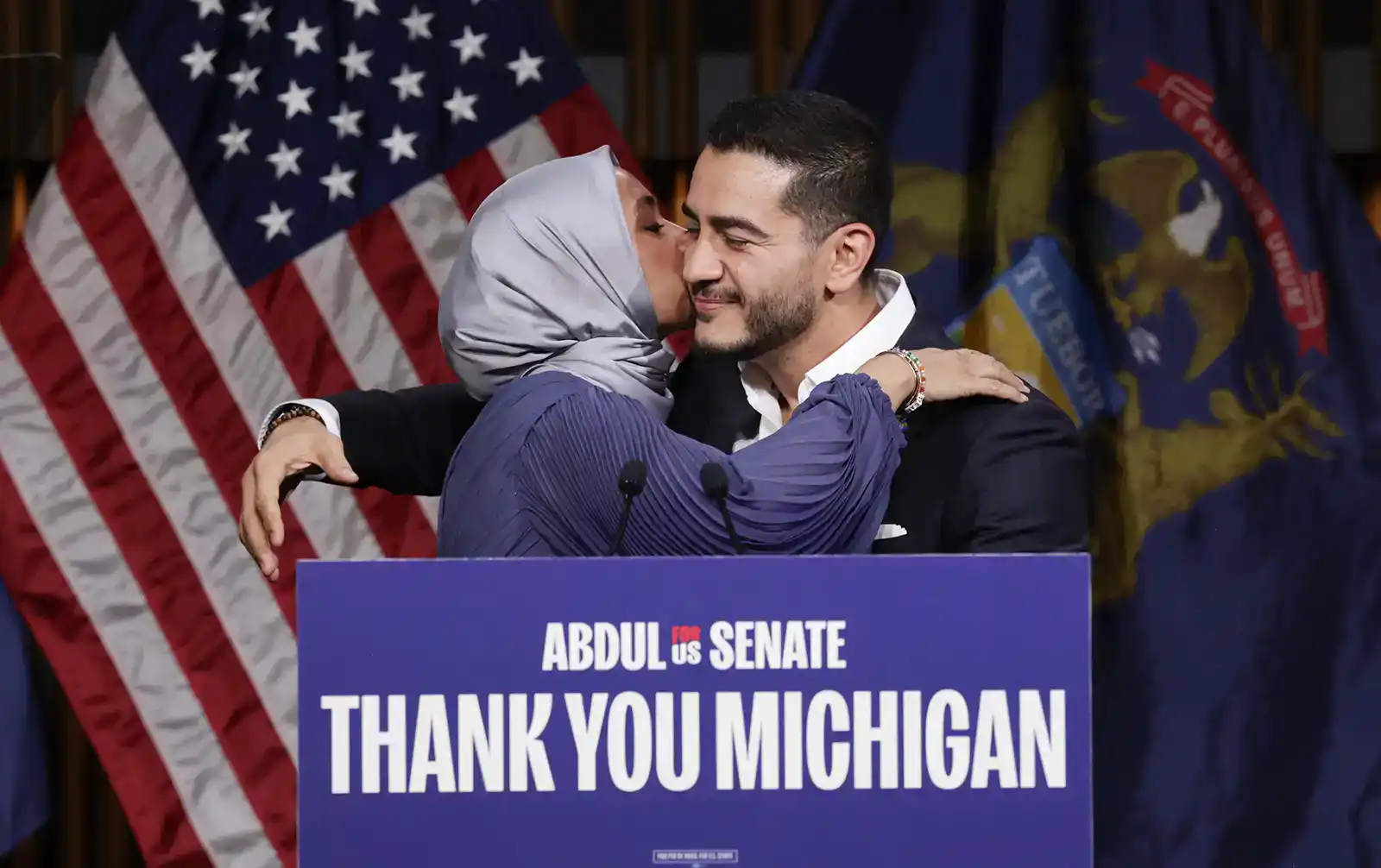
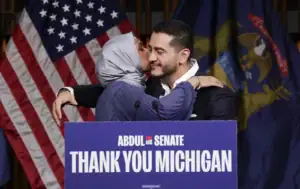
It was not an isolated post. Internet influencers linked to the United Arab Emirates have been amping up rhetoric and false claims against Arab and Muslim Americans in recent weeks, coinciding with the victory of now-Senator-elect Abdul El-Sayed. The goal is clear: to demonize communities that Abu Dhabi views as a threat to its interests.
Abu Dhabi spent the 15 years that followed the 2011 Arab Spring working to subvert democratic movements wherever they appeared in the region, real or otherwise.
- Ali Harb
AlBlooshi has concocted over half a dozen posts targeting Dearborn since the start of November, including one criticizing the city's Lebanese American Mayor, Abdullah Hammoud, over a minor garbage collection delay months ago. The firebrand commentary is one among dozens of UAE influencers who constantly amplify the Gulf country's priorities, including bashing the Muslim Brotherhood and demonizing opponents of the Abu Dhabi-backed Rapid Support Forces (RSF) in Sudan.
AlBlooshi's posts on Dearborn have gone viral. The Power Man sword video has reached three million people, generating thousands of shares and racist responses, including some that allude to violence against Muslims.
"Look at this shit…. where are all MI hunters?" one right-wing X user said in response to the video. Most responses expressed similar or worse, and typically threatening and racist, sentiment.
While AlBlooshi has not linked his attacks on Dearborn to El-Sayed, his newfound interest in Michigan — including a post raising questions over the funding of an Islamic center near Ann Arbor — coincided with the midterm elections. It's hardly a coincidence.
Separately, he called El-Sayed's victory a "dark day for democracy." Responding to the win, AlBlooshi said, "Abdul El-Sayed may have won the election, but he should not mistake victory for immunity from scrutiny."
"Every broken promise and every failure to deliver will be documented and presented. Michigan will be watched," he concluded. "Closely."
Amjad Taha, a prominent Emirati influencer whose posts have been previously shared by Elon Musk and other major right-wing figures, went further than AlBlooshi, explicitly invoking El-Sayed's election in his attacks on Michigan Muslims. He accused what he called "Islamists" in Michigan of waging "ballot-box jihad."
"Muslim Brotherhood mosques in Michigan and elsewhere urged people to vote for candidates because they were Muslim, not because of their policies, qualifications, or whether they were Democrats or Republicans," Taha wrote.
"This is where democracy becomes dangerously vulnerable: when the religious authority of the Islamist Muslim Brotherhood is used to dictate political loyalty, the ballot box risks becoming an extension of the pulpit," he said. "Islamists decided who would represent you in Congress."
Needless to say, the argument is baseless. There is no evidence that mosques urged worshippers to vote for Muslim candidates because of their faith as opposed to their policies. Moreover, many Muslim voters in Michigan follow Shia Islam, and the Muslim Brotherhood is a Sunni group.
The UAE fears the rise of Muslim Americans' political power because it could lead Washington to pressure Abu Dhabi over its regional policies, especially in Sudan, where the RSF has been carrying out genocidal violence.
- Ali Harb
Moreover, while El-Sayed dominated predominantly Arab and Muslim precincts in Dearborn and other cities, he comfortably defeated his staunchly pro-Israel Republican opponent Mike Rogers, winning several Michigan counties that voted for President Donald Trump in 2024.
So, why is an internet influencer and citizen of a brutal autocracy, one who echoes the line of an absolute monarchy that regularly jails authors and dissidents, worried about American democracy? Why should they have any say in the first place?
The answer exists in the UAE's foreign policy approach. Abu Dhabi spent the 15 years that followed the 2011 Arab Spring working to subvert democratic movements wherever they appeared in the region, real or otherwise.
The UAE backed the coup against the first democratically elected president in Egypt, Mohamed Morsi. It supported Kais Saied as he consolidated power and detained opponents in a coup against democratic rule in Tunisia. It continues to sponsor the Rapid Support Forces in Sudan, making the push for a transition to democracy a distant dream. It egged on divisions in Libya and armed the forces of renegade General Khalifa Haftar, expanding the country's civil war to prevent any semblance of democracy from forming. It was one of the first Arab countries to re-establish ties with the brutal regime of Bashar Al-Assad in Syria.
The track record is clear: The UAE and its army of online influencers are not concerned about democracy. They are worried by it.
That worry has been on hyperdrive since Tunisia's Mohamed Bouazizi sparked the flame of protests in late 2010, showing the scale of yearning for democracy across the Middle East and North Africa. For Abu Dhabi, that yearning represents a threat to its authoritarian model and regional vision of repression, whether it's in Sfax or Dearborn.
The fear of that type of mobilization explains why it pushes anti-Muslim sentiment across the West.
As a result, Emirati influencers align with right-wing reactionaries in the West in viewing Arabs and Muslims as unworthy masses who must be subjugated, not empowered.
On a more practical, immediate level, the UAE fears the rise of Muslim Americans' political power because it could lead Washington to pressure Abu Dhabi over its regional policies, especially in Sudan, where the RSF has been carrying out genocidal violence. That explains why UAE influencers have been echoing the unfounded Islamophobic trope that El-Sayed — who has called for holding Abu Dhabi accountable for the atrocities in Sudan — is a member of the Muslim Brotherhood.
Last week, Emirati influencer Rauda Altenaiji claimed that El-Sayed wants to push for a reassessment of U.S. relations with some of Washington's Arab allies, including Egypt, Saudi Arabia and the UAE. Predictably, they blamed the Muslim Brotherhood.
"The Muslim Brotherhood is banned and prosecuted in these countries, so this terrorist org [sic] is seeking revenge," Altenaiji wrote.
In the post-Arab Spring era, the UAE has used the Muslim Brotherhood as a euphemism to dehumanize any side opposing Abu Dhabi's policies or seeking democracy in the region. Now, it imposes the same rhetoric on Muslim and Arab Americans through calculated bashing campaigns intended to spark islamophobia and anti-Arab sentiments.
The views and positions expressed in this article are those of the author(s) and do not necessarily reflect the views of DAWN.