














Hassan Herzallah is a Palestinian writer and translator based in Gaza. He holds a bachelor's degree in English Translation and writes about Middle East affairs, life under siege, displacement and the daily realities of Gaza.
In Gaza, life is no longer measured by normal daily routines. No one plans for the coming months or thinks about the future in the usual sense. Instead, planning is influenced by factors that should be ordinary elsewhere. Nearly three years into Israel's genocide, time has been twisted into a waiting game measured by whatever allows us to get through the day. A short meeting by the sea was enough to show me how the meaning of time has transformed in Gaza since October 2023, and in different ways for different people.
By late June, the summer heat had settled over Gaza. The beaches of al-Mawasi in Khan Younis became one of the few places displaced families could briefly escape the suffocating heat inside their tents. That morning, I went swimming with some friends. It was neither a casual outing nor an attempt to convince ourselves that life had returned to normal. We simply hoped to steal a few ordinary moments from a life that felt anything but ordinary.
Before entering the Mediterranean Sea, we left our phones at a nearby charging station, where people use solar panels to charge their devices. It was only 8 a.m., and the morning sunlight was still too weak for the solar panels to charge the phones effectively. After we finished swimming, we sat on the beach waiting for our clothes to dry and for our phones to charge enough to last the day.
As we watched the phones charge, my friend Yousef suddenly turned to me and asked, "So, Hassan, how does it feel to finally be a graduate?"
In Gaza, life is no longer measured by normal daily routines. No one plans for the coming months or thinks about the future in the usual sense. Instead, planning is influenced by factors that should be ordinary elsewhere.
- Hassan Herzallah
At first, I did not know how to answer his question. It was simple enough, but it also reminded me of all that I had feared to call a future. I had recently graduated with a bachelor's degree in English translation from the Islamic University of Gaza after years of interrupted study and after Israel destroyed the university. Yet the questions that had haunted me before graduation remained the same.
Would I be able to travel to a university outside of Gaza that had accepted me? Or would I remain stuck in the Strip, caught between a degree I had worked tirelessly to earn and a crossing controlled by Israel that I was unsure would open for me after rejecting so many other Palestinians?
Graduation had finally arrived, but it did not feel like the beginning of a new stage of life that I had imagined years earlier. Rather, it felt like a dream in which I had finally reached the door, only to find it locked by someone on the other side.
I am not alone in this feeling. Thousands of students from Gaza hold university offers or scholarships abroad but remain trapped inside the Strip. Israel will not let them leave. At the same time, more than 88,000 students struggle to continue their education inside Gaza through online and temporary learning spaces under fragile conditions.
Yousef's question opened a conversation that revealed the fragility of the lives we have been forced to live at no choice of our own. Each of us carries a small future suspended on a piece of news, a faraway policy decision, a road that may be blocked or destroyed, a tired body skipping meals or enough sun to charge a phone. It feels as if we were not only sitting by the sea but forced to wait indefinitely within different conceptualizations of time itself.
Yousef, who sat beside me, is the quietest among us. His sense of time differs from mine, revolving around his younger brother, who was injured by an Israeli airstrike in July 2025. My friend's days have taken a different shape since that horrific day: sporadic medical appointments, medicine that cannot be found, pain that appears suddenly, hopeful doctor's messages and the possibility of traveling for treatment, which may open and close before it becomes real.
For him, time is not measured by what he accomplishes in a day, but by what his brother's body can endure. Each passing day is more than another day of waiting. It means another chance for treatment to be delayed, for his condition to worsen or for an opportunity to be lost.
Each of us carries a small future suspended on a piece of news, a faraway policy decision, a road that may be blocked or destroyed, a tired body skipping meals or enough sun to charge a phone.
- Hassan Herzallah
Yousef looked at his phone the way we looked at the chargers, but he was not waiting for a charged battery. It was news about his brother: Is there a medical referral? Is there a way out? Can his brother travel for care?
I often heard him talk about his brother as if he were trying to hold time in place. He would often say that his condition had slightly improved. A few days later, he would tell me that new symptoms had appeared, that an appointment had been postponed or that no answer had arrived.
His younger brother's story is not unique either. In Gaza, more than 18,500 patients require urgent medical treatment that is unavailable within the Strip due to Israeli restrictions. They remain suspended in time, forever awaiting as Israel stalls medical evacuations. For them and their families, waiting is not ordinary, and time can be a death sentence. Every delay means more pain, a worsening condition or a chance for treatment to be lost.
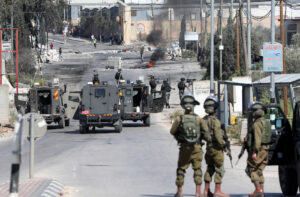
My friend Ahmed, sitting on my other side, carries a different burden. His home was near what has become known as the "Yellow line," the boundary separating the Israel Defense Forces' occupation zone inside Gaza, established after the October 2025 ceasefire with Hamas. The deployment was meant to be temporary, with Israel eventually withdrawing.
What we see on the ground is the opposite: Homes behind the line become unreachable overnight as Israel advances the line daily, leaving entire neighborhoods suspended between news and rumor of any developments that could ease or worsen the horrors of their displacement.
For Ahmed, his home was no longer accessible. In its place are daily questions: Is it still standing? Will I die before I can return to it? When does this end?
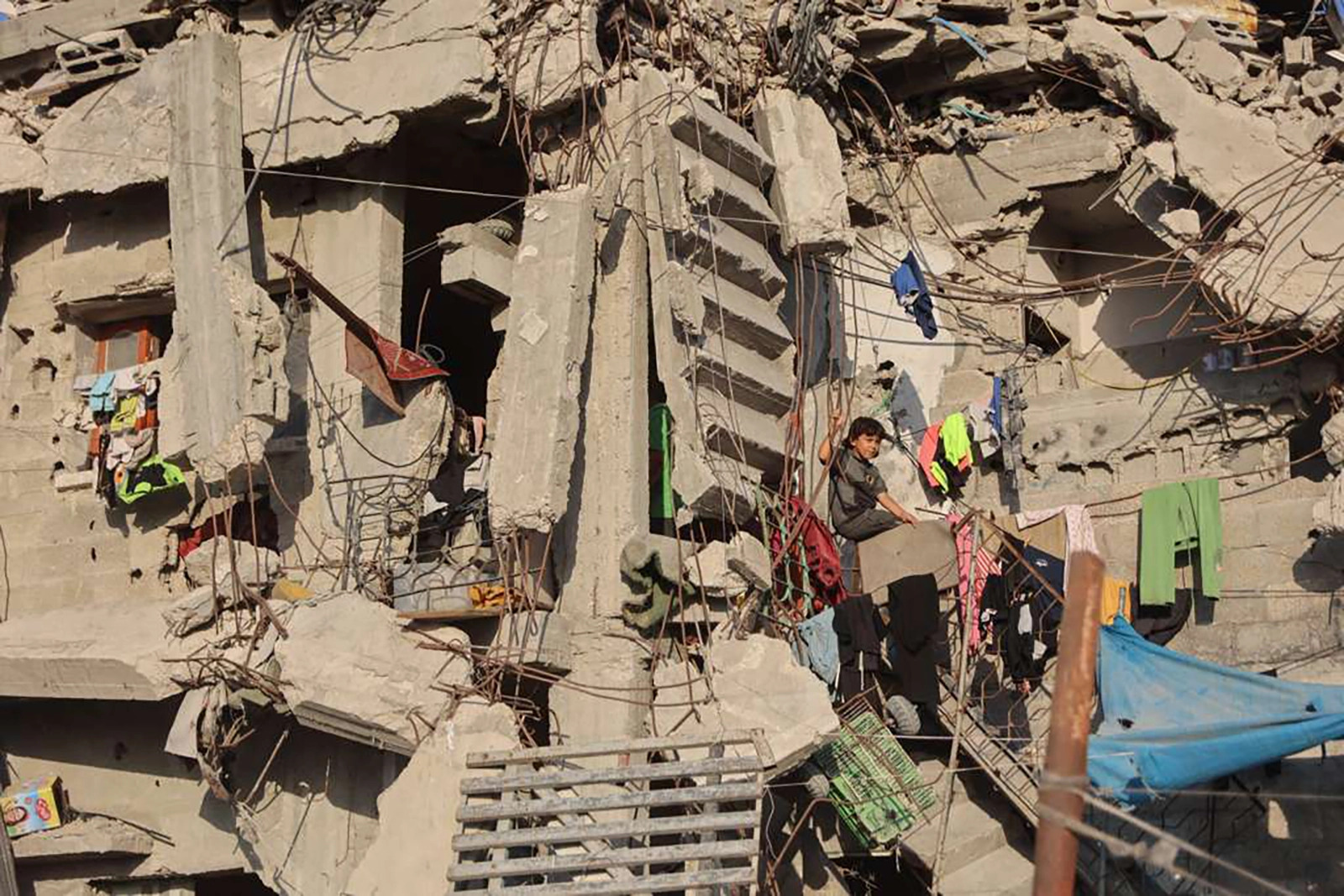
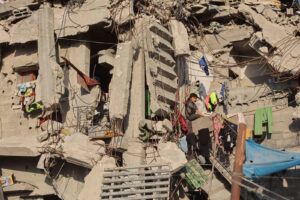
Sitting at the beach, he explained that someone had told him the house was still standing. Still, others said the neighborhood had changed completely, leaving so much uncertainty. Everyone here understands that Israel has leveled large swaths of the Strip, leaving nothing in its wake but lost memories and fading dreams.
He was not only waiting to return to his home. Ahmed waited to know whether there was a home left to return to or mere rubble. He wanted to see his house again; to find out whether the room he had left behind was still there and if the walls he remembered still stood.
Today, Ahmed's story of displacement is the norm. With around 76.6% of housing units in the Strip damaged or destroyed and around 1.9 million of 2.3 million people displaced, Ahmed's question is shared by most Palestinians in Gaza: Does their home still exist, or has the future discovery of loss become part of the waiting as well?
Before the genocide, waiting was a stage between two moments: waiting for the bus to arrive to visit friends and family or for exam results to know if we could advance in our studies. Now, nearly 1,000 days into Israel's genocide and nine months after the so-called "ceasefire," waiting has become a place we inhabit. We organize our days within its shackles, postpone our dreams within its restraints and cling to small routines so that its limitations do not stop time altogether.
As the waves of the Mediterranean Sea crashed ashore amid my reflection on time in Gaza, the owner of the charging station called our names. We grabbed our phones and thanked him, perhaps not realizing the time that had passed.
Our stories may seem different — life after graduation, family medical treatment, a home left behind — but the cause was the same: The Israeli occupation. Sure, each of us waits for a different focus in our lives. Yet, in truth, each of us awaits the same general sense of finality, for life to cease its suspension.
The phones had gained enough power to last the day. For us, it was on to the next waiting period: for the lives that we left on hold to finally resume.
The views and positions expressed in this article are those of the author(s) and do not necessarily reflect the views of DAWN.