













Mohsen Farshneshani is the Principal Attorney at the Sanctions Law Center. He is an attorney and policy advocate specialized in sanctions and economic statecraft reform.
The ballot box can punish a war. It cannot, by itself, account for how the country was led into one.
Republicans' historic midterm rout has made the political cost of the deeply unpopular Iran war impossible to ignore. Even Vice President JD Vance put it bluntly, arguing it was "the reason we lost is the war." But the electoral defeat of the party that waged it marks only the beginning of a larger reckoning with Washington's relationship with Israel and the political interests that helped undermine diplomacy and rush our nation into war. An equally uncomfortable reckoning awaits the Iranian diaspora, whose own political transformation tells a revealing story about how that policy shift became possible.
On Aug. 11, 2015, then-Expedia CEO Dara Khosrowshahi, Google executive Omid Kordestani, Uber investor Shervin Pishevar and 21 other prominent Iranian-Americans signed a full-page letter in the New York Times championing U.S.-Iran diplomacy. That letter was not an isolated gesture. Morgan Freeman, Jack Black and Queen Noor appeared in a Global Zero video urging Americans to support the deal rather than risk another war.
Similarly, the Public Affairs Alliance of Iranian Americans (PAAIA) launched a national television campaign promoting the nuclear agreement, featuring appeals from leading nuclear experts and former Israeli intelligence chiefs. It even joined NIAC and seven other Iranian-American organizations in urging Congress to preserve the agreement.
It is not credible to blame diplomacy for decades of mistrust that Washington only deepened by abandoning the nuclear agreement. The fact that diplomacy was deliberately undermined is hardly grounds for its advocates to abandon it.
- Mohsen Farshneshani
Eleven years later, these public appeals seem almost unrecognizable. Most leaders and organizations have largely gone silent, while some openly funded Reza Pahlavi or even publicly praised the war on Iran. So how did we go from the Iran Deal, formally known as the Joint Comprehensive Plan of Action (JCPOA), to open war?
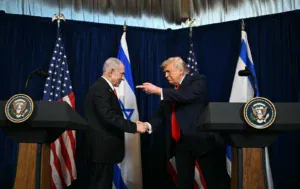
To be sure, substantial resistance to the deal existed before and after it was signed. American conservative pushback was particularly strong, with 47 Republican senators warning Tehran in a letter that a future president could revoke it. Israeli Prime Minister Benjamin Netanyahu and Israel-aligned groups like Foundation for Defense of Democracies (FDD) campaigned aggressively to derail it, with Netanyahu giving a notorious congressional speech against the deal despite the wishes of then-President Barack Obama.
After Trump abandoned the agreement in 2018, Washington climbed the ladder of escalation by reimposing maximum pressure sanctions and announcing the unprecedented 2019 Foreign Terrorist Organization (FTO) designation of Iran's Islamic Revolutionary Guard Corps (IRGC). These moves opened the door for the decision to assassinate Qassem Soleimani in 2020, then-leader of the IRGC Qods Force, its foreign operations arm.
Each successive step further entrenched confrontation as American policy. Meanwhile, much of the diaspora's former enthusiasm for rapprochement gave way to silence or support for coercion, as antiwar voices and advocates of engagement were smeared as "regime sympathizers."
The JCPOA demonstrated what diplomacy could achieve, but Washington proved unable to sustain its commitments against determined political opposition. Iran accepted stringent nuclear restrictions and remained in compliance even after Trump's 2016 presidential victory and subsequent withdrawal from the deal in 2018. Europe's failure to preserve the agreement's economic benefits after that decision, however, ultimately helped unravel the agreement. Iran subsequently exceeded its limits.
What followed was economic strangulation, deadly state repression and destruction. Even as young Iranians successfully drew a red line against social repression through the Woman, Life, Freedom movement, sanctions impoverished families and foreign aggression devastated their country. Israel's genocidal war in Gaza and expanding regional attacks, sustained by U.S. support, culminated in an open U.S.–Israeli war against Iran, including the devastating strike on a girls' school in Minab. Trump's long-promised better nuclear deal never materialized, nor did the liberation supposedly achievable through coercive policies.
The JCPOA demonstrated what diplomacy could achieve, but Washington proved unable to sustain its commitments against determined political opposition.
- Mohsen Farshneshani
In this context, it is not credible to blame diplomacy for decades of mistrust that Washington only deepened by abandoning the nuclear agreement. The fact that diplomacy was deliberately undermined is hardly grounds for its advocates to abandon it. Doing so only surrenders political judgment and collective influence to the very forces that worked to defeat it.
What was sold to Americans as an urgent national security crisis was similarly sold to Iranian-Americans as liberation. The distance between the public appeals of 2015 and today's political silence on the Iran War reflects more than changing attitudes. A fundamental reversal in Washington's approach to Iran occurred, led by the prevailing narratives that negotiation constituted weakness, coercion meant strength and advocates of diplomacy were merely weak or regime sympathizers.
As memories of the 2003 Iraq invasion faded, so did the antiwar sentiment that helped elect Obama and made the Iran Deal possible. Liberal opposition grew timid, with even the non-interventionist factions in the Trump camp sidelined to embrace the war it promised to avoid. Meanwhile, Israel-aligned hawks, interventionist think tanks and the influential diaspora information ecosystem sold maximum pressure and military intervention as paths to freedom — all while discrediting advocates of diplomacy. Reza Pahlavi's political project remains in flux, while neither he nor other exiled opposition figures have offered a viable path from the current coercion campaign to peace, prosperity or democratic change.
As demands to end the Iran war grow louder, the electoral defeat of its architects does not settle the question of how Washington came to abandon diplomacy in the first place. That reckoning must extend beyond the officials who waged the war to the Israel-aligned interests that helped shape the policies leading to it, including their influence over American politics, media and foreign policy.
Iranian-Americans face a reckoning of our own: How did those same forces marginalize advocates of diplomacy and persuade so many of us to embrace — or quietly accept — policies whose devastating consequences our relatives continue to endure?
If diplomacy was worth championing in 2015, its case is exponentially stronger today. The historic Democratic sweep delivered an unmistakable rebuke to a president who squandered his mandate and his promise of peace and no new wars on another devastating conflict. The forces that sabotaged diplomacy have had 11 years to demonstrate that sanctions, intelligence operations and military confrontation could deliver something better. Those who promoted coercion as a path to liberation have only just started answering for what it delivered.
Americans, and those of Iranian descent in particular, should bring the full weight of their voices, votes and influence to bear, not only to restore diplomacy, but to challenge the interests that continually steer our nation toward war at our people's expense. Few communities have greater reason to confront those who sold yet another war as liberation while families abroad experience it as a future held hostage to impoverishment and war.
The views and positions expressed in this article are those of the author(s) and do not necessarily reflect the views of DAWN.