







Dr. Radwan Masmoudi is the President of the Center for the Study of Islam and Democracy (CSID)
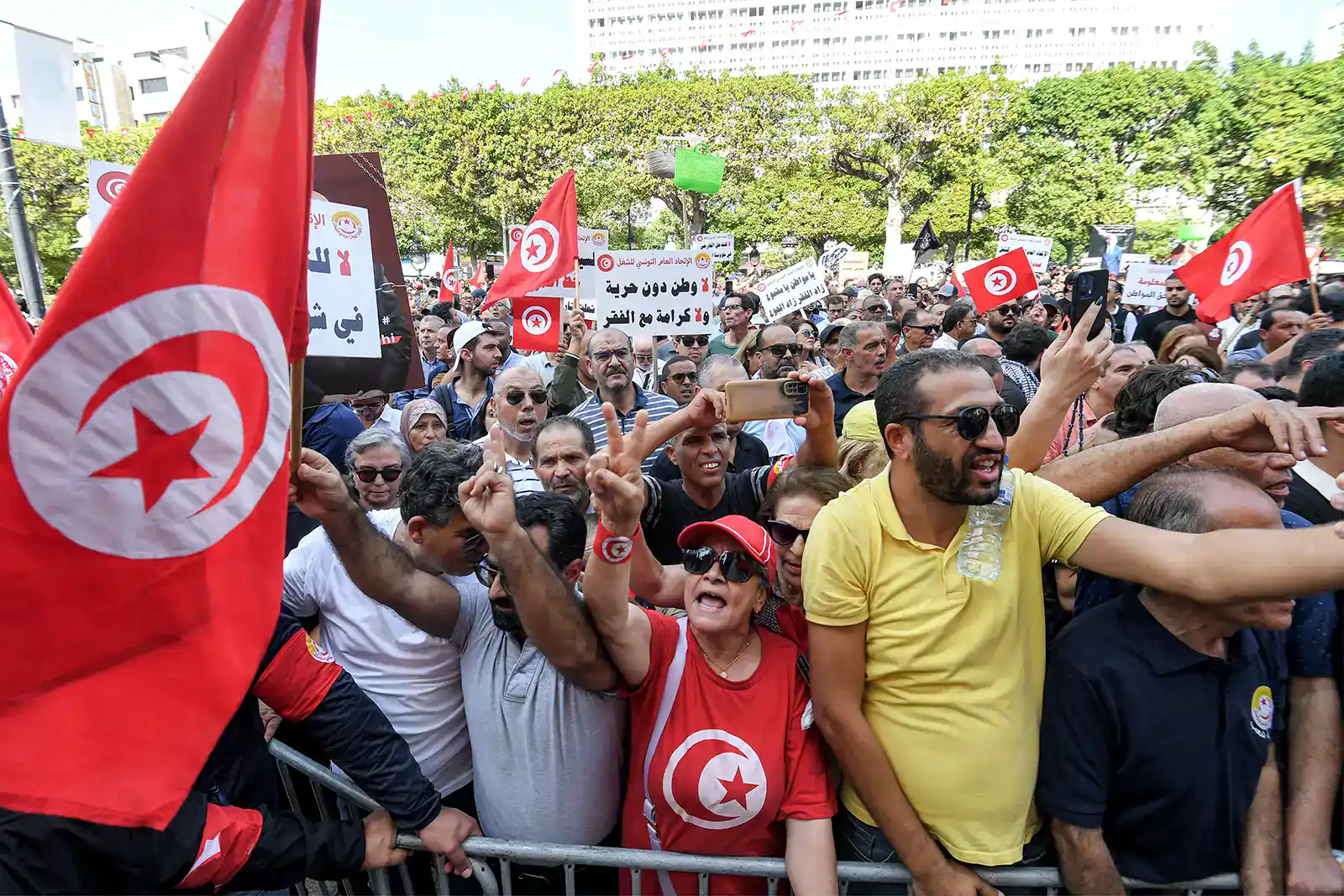
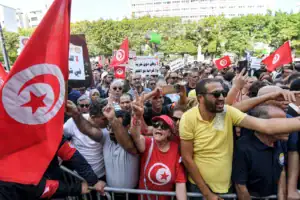
Thousands took to the streets of Tunisia's capital on Oct. 17, the biggest protest since President Kais Saied took control of the country on July 25, 2021. The Tunisian General Labor Union (UGTT) called the demonstrations, a marked shift after previously acquiescing to Saied's takeover. This moment cannot be discounted: 15 years after Tunisians kicked off the Arab Spring, the country could be preparing for a second, but not guaranteed, revolution. That outcome depends on whether Tunisians can unite behind a pro-democracy platform and whether America finally chooses a side.
Islamists, secularists, leftists and conservatives, alongside civil society broadly, joined forces in the latest protests for the first time since Saied's coup. They demand freedom for political prisoners, the return of basic liberties and relief from Tunisia's failing economy, common frustrations across Tunisian society. On Oct. 28, the UGTT and its partner organizations announced a series of new regional and national protests in the coming weeks.
In 2021, many Tunisians agreed to give up some freedoms in exchange for a powerful state that would provide economic well-being. That deal has failed. During the hottest summer recorded since 1950, the state failed to keep the lights on. Blackouts lasting over 10 hours cut off drinking water, fostering over 1,000 protests nationwide for over a month in July and August.
The electricity crisis was not a natural disaster, nor an outlier. The state's electricity and gas utility, the Société Tunisienne de l'Electricité et du Gaz, saw power generation investments fall 87% between 2021-25. Saied, who once spurned the International Monetary Fund in the name of national pride, now relies on Algerian gas to keep the grid running. Food prices rose 8.4% by September, just as youth unemployment has continued to linger above 35%. Foreign reserves, meanwhile, sit at about 90 days' worth of imports, the point where panic buying usually begins.
In 2021, many Tunisians agreed to give up some freedoms in exchange for a powerful state that would provide economic well-being. That deal has failed.
- Radwan Masmoudi
Saied has no one left to blame. For the past five years, he has ruled Tunisia with full executive power under a constitution he alone wrote to strengthen his rule. Attacks on political parties, speculators, migrants and "plotters" are no longer convincing. Protesters summed up their frustration in May: "The people are hungry and the prisons are full." Tunisians know that to fix the economy, they need the rule of law.
Instead of answering this frustration, the regime has prosecuted citizens. Four days after the October protest, a military court handed a four-year sentence to Olfa Hamdi, leader of the Third Republic Party and an American citizen, for social media posts demanding early free and fair elections. In August, authorities arrested 12 people, nine of them minors, after water protests near Mahdia, charging them with plotting against state security.
One political prisoner stands out: Rached Ghannouchi, the last freely elected speaker of parliament. He is 85 years old, in declining health and has written over 30 books on Islam and democracy. In June, he was given a life sentence on false charges, atop a century of prison sentences in previous cases. A United Nations working group declared his imprisonment arbitrary, as has Amnesty International. Human rights groups have similarly documented dozens of other high-profile political detainees, with the total remaining difficult to ascertain.
In 2014, Ghannouchi compromised with secular parties so Tunisia could agree on a constitution. He must be released immediately, alongside Tunisia's many other political prisoners. From Islamists to left-wing secularists, Tunisia needs a national conversation, and that cannot happen while its political leaders remain behind bars.
In this context, Saied has few tools left to stay in power. He has no political party or patronage network like former dictator Zine El Abidine Ben Ali once boasted. He claims few allies abroad outside of Algeria. There are few, if any, successes he can point to.
I believe the protests will grow through the winter. If so, Saied will be tempted to crack down harder. When that happens, he is likely to lose the support of the army and the police, just as Ben Ali did in January 2011. That moment will carry its own dangers of turmoil and instability.
From Islamists to left-wing secularists, Tunisia needs a national conversation, and that cannot happen while its political leaders remain behind bars.
- Radwan Masmoudi
Consider Saied's decision to pull the military into politics to bolster his rule, using military courts against civilians and naming officers to cabinet positions. Given their expanded role, Tunisia could see another "savior" figure step in with the backing of the army after any Saied collapse. That outcome will not foster genuine democratic change.
In this context, the political opposition must be prepared. They need a unifying platform, which should first reject Saied's constitution. Fewer than one in three voters participated in the 2022 referendum, making a new referendum on a revised 2014 constitution necessary. That effort must restore checks and balances to Tunisia's political system to prevent another power grab.
The 2014 constitution, Tunisia's only democratic constitution, offers a solid starting point. It passed with the support of nearly 93% of the elected assembly. At the same time, a simple return to the pre-Saied era is inadvisable because much went wrong with the post-revolutionary system. Three amendments can help thrust Tunisia forward.
First, Tunisia should adopt a parliamentary system. The 2014 constitution divided power between the president and the prime minister, producing repeated standoffs that incentivized a directly elected president with both the mandate and the means to seize power. During a difficult democratic transition, centralizing power in one individual is risky. The government should answer to parliament, with a largely ceremonial president or no president at all.
Second, a firm deadline must backstop the establishment of the Constitutional Court. Its absence allowed Saied to interpret his emergency powers as he wished in 2021. This court is crucial to the checks and balances Tunisian democracy requires.
Third, stability must define the governing system. A constructive vote of no confidence would allow parliament to remove a government only by electing a new one. An electoral threshold of at least 5-10% would reduce fragmentation in parliament. An independent Supreme Judicial Council elected by the country's judges, which must be restored, would further check any potential power grab.
These steps should occur during a one- to two-year transition period, under a consensus government focused on improving the economy and release political prisoners while preparing for free and fair elections.
An international component will play an active role, just as it did previously. America refused to define Saied's power grab in 2021 as a coup. Saied acted accordingly, understanding there were no consequences for his actions. Still, U.S. Foreign Military Financing has dropped from $85 million to around $20 million since then, and only one senior U.S. official has traveled to Tunisia since 2025. Yet Saied does respond to pressure, as we saw when Sonia Dahmani was released from prison.
In this regard, Washington can take a few helpful steps. It can speak out publicly for the release of Rached Ghannouchi, Olfa Hamdi and all political prisoners. It should make clear that aid depends on releasing these prisoners, as members of both parties in Congress have proposed. Military cooperation should continue, but not if force is used against peaceful protesters. U.S. officials should work with European partners and international lenders to provide economic support to Tunisia once constitutional order is restored, including bringing back a Millennium Challenge Corporation compact. Finally, the United States should engage the UGTT, political parties and civil society across Tunisia.
In 2011, Tunisia proved to the Arab world that its people can topple a dictator. While Saied's one-man rule is failing, what comes next is difficult to project. Will Tunisia get another dictator, or the democracy Tunisians tried to build in 2014? Another Arab Spring is possible but fragile, requiring careful decision-making in both Tunisia and the United States.
The views and positions expressed in this article are those of the author(s) and do not necessarily reflect the views of DAWN.