



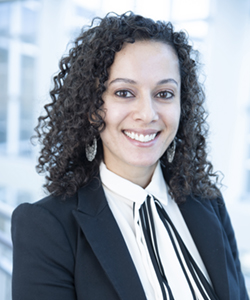
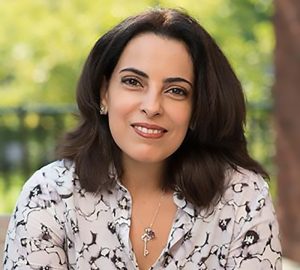
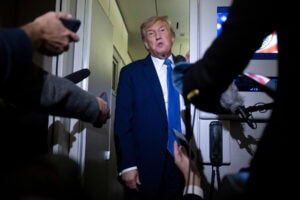

Maggie Mitchell Salem is executive director of IRIS: Integrated Refugee and Immigrant Services. She directed NDI's Tunisia program, was founding executive director of Qatar Foundation International, and led IFES's MENA programs. A former U.S. Foreign Service Officer, she was also a Fulbright Scholar in Syria.

Omar Shakir is the Executive Director of Democracy in the Arab World Now (DAWN), the organization founded by Jamal Khashoggi that seeks to end U.S. support for repressive regimes in the MENA, and formerly served for nearly a decade as the Israel and Palestine Director at Human Rights Watch.
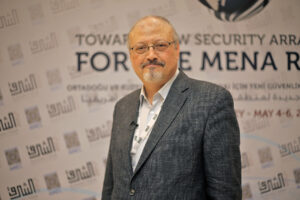
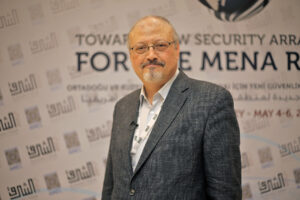
On the morning of Oct. 2, 2017, Jamal Khashoggi texted Maggie: "I'm going to [the] embassy, I should leave by 10.45." He meant the Saudi Embassy in Washington. "Ok," she wrote back.
Maggie and Jamal were friends for more than 15 years and she was deeply concerned for his safety. Jamal had just published his second op-ed in the Washington Post. The Saudi government responded by attacking him online through their bots and trolls, and by setting people up to discredit him.
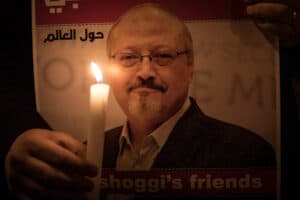
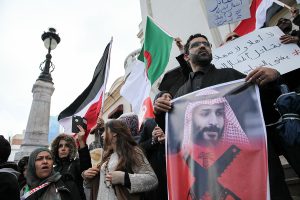
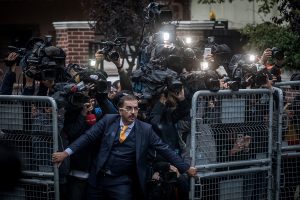
Exactly one year later, Jamal walked into the Saudi consulate in Istanbul. A 15-man team flown in on Saudi government jets killed him there and dismembered his body. The CIA concluded that Crown Prince Mohammed bin Salman (MBS) "approved an operation in Istanbul, Turkey to capture or kill Saudi journalist Jamal Khashoggi."
On the morning of Oct. 2, 2017, Jamal Khashoggi texted Maggie: "I'm going to [the] embassy, I should leave by 10.45." He meant the Saudi Embassy in Washington. "Ok," she wrote back.
- Maggie Mitchell Salem and Omar Shakir
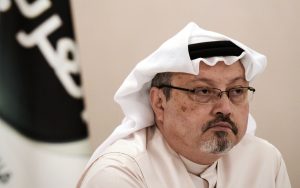
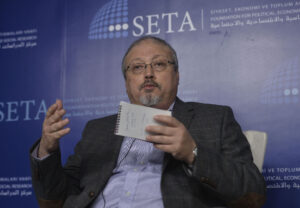
Khashoggi, a widely read columnist in the Arab World, had just joined the Washington Post in September 2017. Once close to the Saudi regime, he wrote about his concerns about the direction of the country under the crown prince and was twice fired as editor of the Saudi daily Al-Watan for pushing the limits on editorial freedom.
Jamal left Saudi Arabia for the U.S., he wrote, "to have my freedom back again." It was painful, he added, to stay silent every time a friend was arrested back home.
Eight years after his murder, we question whether Jamal would feel safe as a political exile of a U.S. ally in today's America. Could he have met the same fate in the Saudi Embassy in Washington, or walking to his next meeting in New York, San Francisco or Boston?
Last week the Justice Department charged five people in a Kremlin-directed plot to kill dissidents in the U.S. and Europe, including a Russian agent who offered $40,000 to "eliminate" a prominent Russian dissident near Washington. "The rules have changed in America," the journalist Roman Dobrokhotov told The Guardian. "Nowhere is safe."
Russia is not alone. In June 2023, masked gunmen killed Sikh activist Hardeep Singh Nijjar outside a temple near Vancouver. Canada's government cited "credible allegations" of Indian involvement, which India denies. That same month, U.S. prosecutors say, an Indian intelligence officer paid $100,000 to kill another Sikh activist in New York. The middleman pleaded guilty in February, though the officer who gave the order was never arrested.
If Moscow and New Delhi will try this in the United States and elsewhere, the question for Riyadh, Abu Dhabi or Tel Aviv is not whether they could. It is whether they would get away with it.
The track record of impunity suggests they would.
A former Twitter employee stands convicted in U.S. courts of passing Riyadh private data on its critics, including Abdulrahman al-Sadhan, an aid worker who ran a satirical account. The Saudi official who recruited the Twitter employee was never tried, and a second recruited employee fled to Saudi Arabia. Al-Sadhan, arrested by Saudi officials in 2018, is serving 20 years in prison, cut off from his family.
A lawsuit by former Saudi official Saad Aljabri, pending in Washington, alleges a hit team followed him to Canada weeks after Jamal's murder and that Saudi students tracked his family in the United States. Two of his children have been detained in Saudi Arabia since 2020.
Jamal walked into the Saudi consulate in Istanbul. A 15-man team flown in on Saudi government jets killed him there and dismembered his body.
- Maggie Mitchell Salem and Omar Shakir
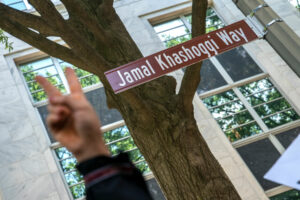
Jamal wanted to build what he called a "democracy for Arabs movement." He founded Democracy in the Arab World Now (DAWN) but was killed before it launched. His friends brought his vision to life and DAWN, now run by Omar, has since documented the Kingdom's reach: Saudi officials "regularly rely on social media to surveil and harass dissidents living abroad," including Americans. Saad Almadi, a U.S. citizen, posted 14 tweets from Florida — one urging a street be renamed for Jamal — and was arrested visiting Riyadh in 2021, later sentenced to 19 years. Released in 2023 but barred from travel, he went free only after Washington pressed his case during an MBS visit to the White House, offering proof that Washington has the power to protect dissidents abroad.
Yet in 2018, President Donald Trump made clear the CIA's findings on MBS's role in killing Khashoggi did not matter to him, dismissing the report. Last November, with the crown prince beside him in the Oval Office, Trump told ABC that his guest "knew nothing about it" and that "things happen," then suggested revoking ABC's broadcast license. That week he made Saudi Arabia a major non-NATO ally and approved the first-ever F-35 sales to the Kingdom. His family has profited from billions in projects with Saudi Arabia since he entered the White House.
Worse, Washington is taking pages from the playbook of repressive regimes. In 2020, an American drone killed Iran's Gen. Qassem Soleimani in a strike widely considered unlawful. Since September 2025, the U.S. military has killed more than 230 people on small boats in the Caribbean and Pacific, labelling them "narco-terrorists," in what many similarly view to be unlawful strikes. United Nations Special Rapporteur Ben Saul said last month that the strikes may constitute crimes against humanity. In January, U.S. forces seized Venezuelan President Nicolás Maduro and flew him to New York for trial.
The administration has also shut down asylum, deported people to third countries where they face abuse, barred thousands of vetted refugees while resettling mostly white South Africans and revoked students' visas over protected speech. A new Amnesty International report documents abuses by U.S. Immigration and Customs Enforcement (ICE) and Customs and Border Protection (CBP) of the kind the State Department's own human rights reports once catalogued abroad.
Even without new legislation, enforcement of laws already on the books would go a long way towards curbing U.S. complicity. The Arms Export Control Act bars arms sales to governments engaged in "a consistent pattern of acts of intimidation or harassment" against civilians. The Foreign Assistance Act and Leahy Laws bar aid to governments and units implicated in gross rights violations. On Sept. 17, three senators introduced a resolution to block a planned $5 billion bomb sale to Saudi Arabia, highlighting a legislative path as well.
No arms should reach Riyadh, or any regime, while it engages in systematic repression. Congress should insist that the Justice Department prosecute both the agents who stalk and threaten people around the world and the officials who send them alike. The attorney general should not narrow such cases, as former AG Pam Bondi did last year, to conduct resembling traditional espionage.
In November 2017, Jamal was nervous about giving a speech at Princeton University. He said yes anyway, to tell the leaders back home: "You won't silence me."
They killed Jamal, but they did not silence him. Each of us can channel his voice by advocating for an end to U.S. support for repressive regimes, and for America to be a safe haven for the Jamals of this world.
The views and positions expressed in this article are those of the author(s) and do not necessarily reflect the views of DAWN.