


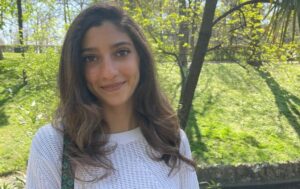



Sophie Holin was previously the Communications Manager at DAWN. She currently manages the Human Rights, Gender and Equity and the Technology, Policy, and Innovation Concentrations at Columbia University's School of International and Public Affairs. She is also a graduate student at Columbia School of Journalism. She has been a freelance illustrator for various nonprofits, as well as social and environmental justice movements. You can find her illustration work on Instagram @illustratoria123 and on X @sophieholin.
"Paradiso 17," Hannah Lillith Assadi's latest work, recounts the refugee story of a Palestinian man. A figure deeply inspired by her father, Sufien begins the novel on his death bed in Arizona. The reader is transported to Palestine during a time of relative peace on the precipice of the Nakba, as seen through young Sufien's innocent eyes.
The reader goes on to live through the vast spectrum of experiences a lifetime in exile can hold: trauma, sin, guilt, gratitude and love in all its forms. Time maintains a steady arc throughout, except to disrupt at certain moments that reveal its cyclical pattern and parallels between generations.
Though the novel's title, "Paradiso 17," is a direct reference, Dante's "Divine Comedy" is not overtly referenced throughout. With their shared perspectives as outsiders in exile, Sufien's story echoes Dante's epic journey of a soul punished, cleansed and enlightened. Like Dante, Sufien ascends toward an ultimate homecoming, carried by a cast of characters through realms that unveil different parts of him.
On a cold mid-February evening, I found Assadi leaning back in the corner booth of a bar in her neighborhood of Brooklyn, New York. She is now seven months pregnant. Following the March 17 publication of her novel, she told me she is peacefully resigned to whatever life it takes on after its release. She is currently teaching a graduate seminar on fiction at Columbia University called "Death and Desire".
The following interview with Assadi explores how, driven by grief and an urgent impulse to document her father's story, the novel poured out of her in the days leading up to his death and in the year that followed. Assadi reflects on how October 7 forced her to reframe the novel, the consistencies and divergences between her family and the characters, her fixation on the supernatural — born of her dreams, the desert, and Toni Morrison's "Beloved."
Though some of it is really inspired by my father, Sufien is also my character. Some of it is my own midlife reckoning.
- Hannah Lillith Assadi
With one leg always over the railing, Sufien challenges romantic notions of suffering and embraces others without fear of contradiction. An unceremoniously tragic end to his quest for "home" only scratches at the injustice of the Palestinian story of exile. For most Palestinians living abroad today, exile is the reality.
For those denied justice during their lifetime — and for those that continue to be deprived today — Assadi's use of the supernatural offers a kind of reprieve. Her use of magical realism begs the most pragmatic and unsparing questions. After all, Sufien asks, "What was Palestine if not a ghost story?"
***
I think it could be helpful if you start by talking about the beginning of your life.
I was born here in New York City at Lennox Hill Hospital, much like Leila's character in the novel. My parents met at a bar in Tribeca in the 1980s. I lived here in Brooklyn as a kid. My father had a sort of mental situation — it was a full breakdown. He also had a shoe store here, and it unfortunately went out of business and he went bankrupt. He went to visit an old friend that he knew from Italy in Arizona and decided to move us out there. I moved to Arizona before kindergarten started, so I must have been five. All of that mimics what's in the novel.
I grew up in Arizona from five to eighteen, and then I got into Columbia [University] for undergrad. At first, I wanted to study astronomy, and then I decided to major in MEALAC [Middle East and Asian Languages and Cultures]. It's now MESAAS [Middle Eastern, South Asian and African Studies], the famous department that's now under receivership.
At the time I entered as a freshman, the documentary "Columbia Unbecoming" came out. It was supposedly an exposé about antisemitism at Columbia, focusing on these professors in this department for the most part. But of course — well in my opinion — it was focusing on the professors who were critical of Israel and Zionism. So, there was a lot of controversy at the time in that department.
Did that trickle down into your studies?
It did. The whole time I was there, I remember hearing about people recording our professors in our classrooms. You know, it's not that different now. A heated time then too. When I graduated from college, the path felt split between pursuing a more academic route like a Ph.D. or really committing myself to my writing. I decided, for better or worse, to commit myself to my writing.
When did you start writing "Paradiso 17?"
I started the book when my father was on his deathbed. He was in hospice. I remember starting to write the first chapters. It was maybe two weeks before he passed away, in October 2022. And then I drafted it every night after he was gone, for a year, until October 2023. That year, I drafted every night. And then — we all know what happened in October 2023 — I revised it and sent it to my agent in November. He read it and sold it in the Spring.
I remember writing chapter one while he was in hospice, and it was very clear there was no turning back. This scene of trying to write from the perspective of a man on his death bed — I didn't do anything more than that while he was alive. But after he was gone, I was in such deep grief. I also had a three month old. In the novel, the character, Leila, is still pregnant, but in my case, I had a very young baby who really needed me. So, there was no falling apart, and the only way to manage the grief was just to put it somewhere.
Did you have a vision for "Paradiso 17" in mind when you started?
No, I just knew I wanted to write my father's story with this sort of immediacy and the urgency of grief that I was feeling. I wanted to get it all down. So much of it is fictionalized because [there is] so much I really don't know, like Italy and early New York. The only thing I really know, as much as anyone can know about, is Arizona. I think at the beginning, it was just like, "Let me just write down everything I know about his life or that I can imagine." And then it started to form.
How do you think your writing was impacted by grief?
In "Paradiso 17," it's all grief. It's an attempt to keep something of my dad. But also, I think the supernatural quality, which was present in "Sonora" and in my second book, has always been an interest of mine. But it's much more on the surface in this novel because I was having really beautiful and strange dreams and also, I was reading a lot about the afterlife. I was teaching a class on representations of the afterlife in literature and reading a lot about near death experiences. I was very much in that territory. I mean, "Paradiso 17" is from Dante's journey through the afterlife. So, it definitely pushed me into an interest that was there — present in my writing through all the books — but much more so.
In a tragic way, Sufien envisions all these other ways life could have gone, but then realizes everything he has at the end, almost too late. Was this something you were thinking about?
Though some of it is really inspired by my father, Sufien is also my character. Some of it is my own midlife reckoning. But I think my father had deep regret too. One of the things that he expressed at the end was deep regret that he hadn't followed his doctor's advice earlier. That was one of the things that made me really sad — how much he regretted. I think part of the book was also this impulse to be like, "See, it was beautiful, too."
It was difficult, but I also think this relates to Palestine as well. [My father died in] October 2022. Between May of 2021 and October of 2023, nobody was talking about Palestine. I think that was the moment that my father died and felt like, "What the fuck what that all for?" Like, "nobody cares. It's never gonna change. I'm never gonna get any recognition, there's never gonna be a reckoning."
I think by the end, he felt, "Well I just need an apology," you know? I think he really died feeling like there would be no reckoning. That is another thing that's really deeply ingrained in the novel, because of course, I was finishing it and revising it [on] Oct. 7 and beyond.
How did Oct. 7 influence your writing?
I was editing but it didn't change it too much because I didn't want to touch it. As I remember, it did change the framing because as the character is on his deathbed in the novel, Oct. 7 is happening, and the beginning of the genocide is starting. But he's not aware of it. I felt like it was important to acknowledge since the novel tracks every war from 1948 on. But the character also couldn't be aware of what was happening, which was true. My father was gone [when Oct. 7 happened]. [In the beginning of the book,] it was 2023 and you know that it's on the periphery — but it wasn't there in the earliest draft.
Can you speak a little more about the timeline of your writing?
It's so hard for me to really understand what I did. It was almost like I was in an altered state. My dad just passed. I was writing it late at night. I probably had a glass or two — or three — of wine by then. It just sort of came out of me. So, it's very hard to know; it's hard for me to understand. When I had finished the draft, I didn't even know what it was. And no one read it. I revised it over the course of a few weeks and then I sent it to my agent. I was like, "who knows what the fuck this is," which I'd never done before.

This is an image caption lorem ipsum dolor sit amet, duo purto brute disputationi eu
Paradiso 17, written by Hannah Lillith Assadi
I also want to say that when I was drafting this novel, Columbia did play a big role. When Sufien comes to New York, he lives near Columbia. He's very envious and passionate about it as an institution. [His American friend] Bernardo says to him, "You could maybe even go to Columbia." It's this place in Sufien's mind — always of worship and envy.
I will say that all was written before what happened at Columbia since October of 2023. So, that all had to change because I had to acknowledge the shift there. There's this moment that addresses the past years at Columbia that wasn't there before and that my dad never saw. I said what I wanted to say. And just to add, there's deep love and deep disappointment for the institution.
Spiritual realms, ghosts, homecoming, Palestine — all of these themes feel very connected. Is there one thread that felt most cathartic to weave into the novel?
Probably the most cathartic was the supernatural, spiritual elements — [especially] in relation to Palestine. My father is of a generation of children who left or were kicked out in 1948. The likelihood of their return, or of any sort reckoning with what happened, is diminishing. I'm not saying that it might not happen later, or for future generations, or that there won't be justice. But there won't be justice for that generation, most likely.
So, there was no way to give him, or those people who were born in that version of Palestine, a happy ending without a supernatural turn. It had to become unreal. So, in some ways, I'm interested in the supernatural and the spiritual because I want to believe — and I do — in a realm beyond this corrupt one. It is also related to Palestine, at least my father's Palestine, that he will never see or return to. So, the only way to give him a return or a homecoming was for it to be a transcendent one, like one in an afterlife.
That idea that there is no one coming to save you. Sufien is thinking to himself at one point closer to the end, "Life, Sufien's life, was supposed to end triumphantly. That was what Hollywood always forecasts. Where was his great reward after all that pain?" Do you think of this novel as a salve to this feeling that we all share, to some extent?
No. I hope the novel evokes in the reader a sense that your dreams and your imagination are little portals to a place that's bigger and more generous than this one. But no, I don't think that it's a salve to what happens here.
Do you personally think that dreams are worth paying attention to?
Yes, at least for me personally. I really rely on my dreams. I write them down as soon as I wake up. I don't feel like all dreams are messages or populated by messengers, but I do feel like sometimes they're bringing us something that we can't receive in our conscious, waking life.
My dad always had really strong dreams. And my mom has been starting to dream more, which is interesting. But my dad was always big on dreams. I just remember he would wake up from something that was really upsetting — and they were always poetic and rich. I remember that when he would have a bad dream, it was often accompanied by a Charlie Horse. I don't have that, although they do come with being pregnant because of your magnesium levels.
What other themes did you enjoy in the novel?
I think those are the big ones: mortality, exile, justice, love. Sufien is a big lover. He's really imperfect and self-destructive. The character — and my father — was like this. And I'm like this. I hope — totally imperfect and fucked up but really loves people, almost to a naive extent. And he doesn't always follow the rules. There's a love between a husband and wife. There's other loves, like the friendship between him and Bernardo. That is really important in the novel.
I think that relationship in a way holds a complexity that just any romantic relationship can't. Or maybe there's just so much complexity there that it actually makes it hard? In a romantic relationship, they have to live together, they have to make money together, they have a child together. With Bernardo, it could just be like a complex friendship between a Jewish man from an upper class family who has nothing to do with the state of Israel in many ways, but just so happens to be associated by virtue of being Jewish. And then they encounter each other in Italy. And Sufien is this Palestinian who has lost everything. So, I think their friendship can hold more of that dynamic in some ways, whereas a marriage has to address so much more.
I hope the novel evokes in the reader a sense that your dreams and your imagination are little portals to a place that's bigger and more generous than this one. But no, I don't think that it's a salve to what happens here.
- Hannah Lillith Assadi
Do the Palestinian-Jewish relationships in the novel reflect your own experience in some way?
Well, I think it was important to assess the relationships from his perspective. All my life, I was asked to address it from my perspective. I'm just, I'm not sure. I'm a Palestinian-American who has a mother who grew up Jewish. I don't have a relationship to the state of Israel. I grew up around my Palestinian cousins, I grew up on Arabic, I grew up on the food. My mom is an American-Jew from Alabama. Their family came in the late 1800s from Eastern Europe and they don't have family there. So that's the tradition, actually, of persecution. That's the common thread. But I think it's taken me a while to untangle the projection.
In an ideal world, that's where I position myself, as a Palestinian-American-Jewish person. Of course that's not going to be the way I'm seen, and so it doesn't matter. But I think, in terms of the novel, it was really important for me to see it from the perspective of the person who has suffered the most from this encounter in history — in my life — which is the character inspired by my father. My mother certainly suffered, from marrying him and dealing with his shit. But my dad and the Palestinians were the ones who lost everything. So, for the most part, it was important to address it from that [experience], versus mine. I grew up here. I've inherited loss. But I'm a New Yorker.
In the novel, Sufien's relationships strike me as very pure. Whenever he and your mother's character were fighting, it was always all love in the end. It was never about anything political in that he never saw individuals in terms of occupier versus occupied.
No, no. Certainly the attraction to Jewish women, it's not like that came from nowhere. There was sort of a desire for the other. It's not an uncommon phenomenon among Palestinian men or any oppressed people. But no, my dad didn't use that language. I mean, certainly not in terms of people on the ground. [Only] in terms of the state or the entity, or the government.
He also grew up in Italy, and he lived in New York for a long time. I think he felt like he had left home, so he almost felt like he didn't belong, like, anywhere, you know? Certainly, he was a Palestinian man — that was a pretty huge part of his identity. But I also think there was some insecurity there, because he had left so young, and because he had lived in the West, and because he liked to indulge and he drank and he wasn't, like, a proper Muslim. I think he also felt like he had become of the West in some ways.
My "teta" — my paternal grandmother — was a character. She barely spoke English and she was the loveliest. She was crazy and traumatized but tough as fuck. But she was always very nice to my mom. My dad's explanation for that was just that in that generation, they lived with Jewish people for a very long time. So, it wasn't like she had an inherent [fear]. She could differentiate between the [leaders and] the people. I think at one point there was even a Jewish doctor they relied on. They had lived together before colonization for a long time. It wasn't a problem until it was a problem.
Do you have expectations for how you want the world to engage with your writing?
I think there's maybe a little instinct that it could do something, but I do think the first instinct is just to write. And then, later, there was an idea that maybe it would help somebody or something like that. But it really is a very selfish instinct, or impulse. As the writer, you start to let go. It's so out of my hands at this point. It's gonna be printed in a month. There's nothing I can do. I can go to events, I can talk to you about it, but there is this sense that my time with it is way past. It is no longer mine.
Do you think Dante is an important part of the novel?
Yeah. I don't think you need to know Dante or know the "Divine Comedy" to read the novel in any way, but I do think Florence is a huge place for the character and the novel. In many ways, when Sufien is in Florence, he is at his best. It feels like his spiritual home. It's where he meets Bernardo; it's where he meets his friend, Malik; it's where he works at the market. It's this turning point in his life. And of course, that was Dante's home. As a figure of exile, a figure who wrote about a journey through the underworld and into paradise. But do you need to know that? No.
The title is important. In Dante's "Divine Comedy," the inferno is the first part of the book of hell. Purgatorio is the second part, and paradiso is the final part, which is Dante's journey through paradise. "Paradiso 17" is the canto in which Dante's exile is prophesized. When he's in paradise, he meets this ancestor in heaven and the ancestor tells him he will be exiled from this place that he loves. That's the epigraph in [the book].
Have there been other works that influence you or that you keep in mind when you are writing?
Probably anything that I taught in the afterlife course at Columbia. Definitely Dante, and definitely a novel I read over and over and over and over and over again: "Beloved," by Toni Morrison. You could see I was trying to use some of her brilliant technique and craft. I read "Alf Layla wa-Layla," "One Thousand and One Nights." Then I read "Beloved" over and over — I forget how many times. It's just a total masterpiece. It's a ghost story. It's the story of American slavery. It's supernatural but it's also deeply historical. For that reason, it does all the things I'm trying to do. When I say I am writing about Palestine when I'm being supernatural — that's in "Beloved" too. She's doing it all.
The views and positions expressed in this article are those of the author(s) and do not necessarily reflect the views of DAWN.