










Ali Harb is an independent journalist based in Washington, DC. His work focuses on U.S. elections, politics and foreign policy, as well as geopolitics in the Middle East.
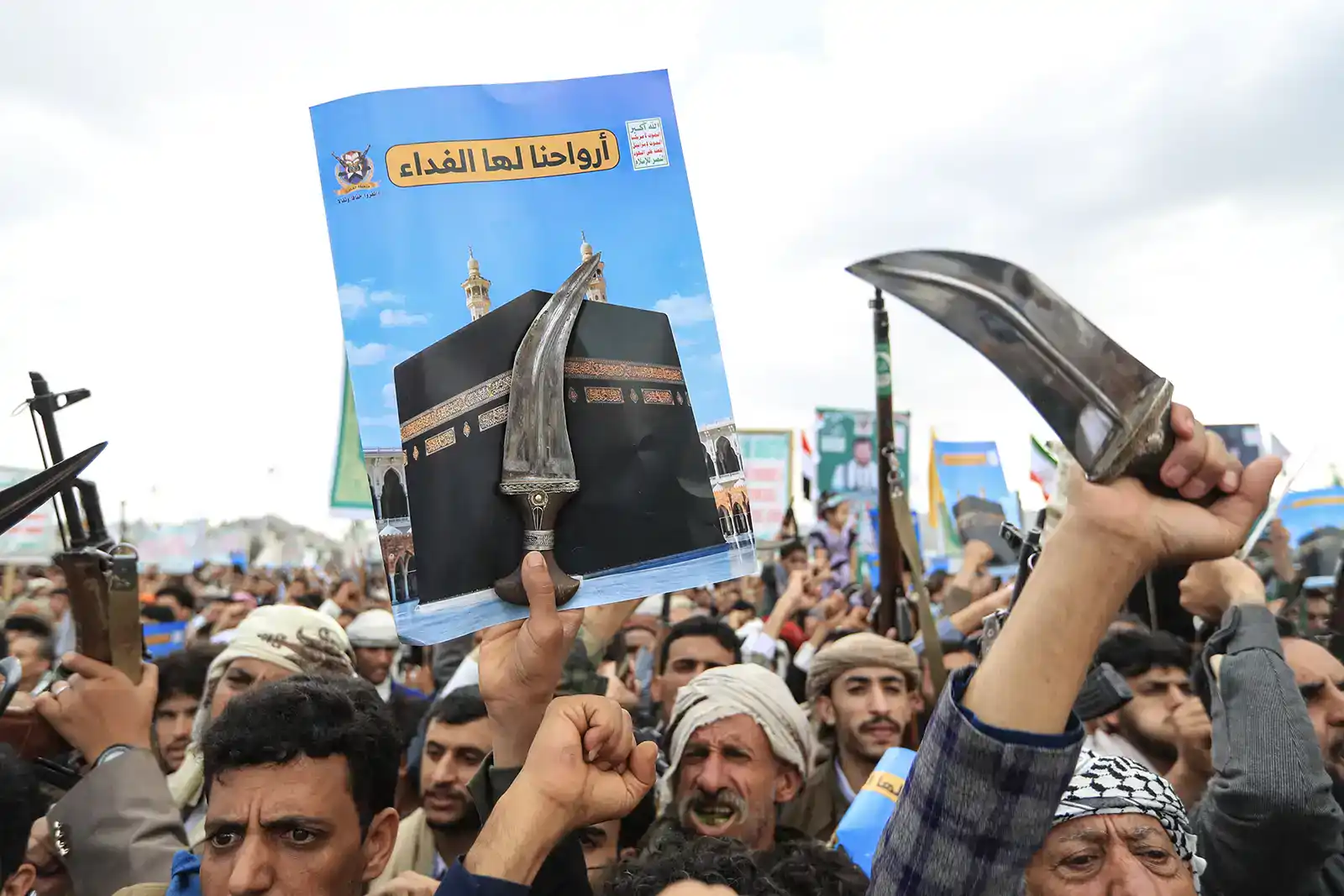
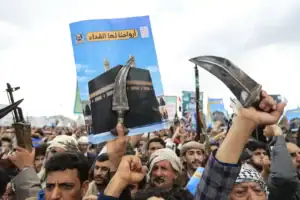
As Saudi Arabia pushes to rally domestic and regional support for its war against the Houthi Movement, also known as Ansar Allah, in Yemen, the kingdom has increasingly relied upon religious messaging that often veers into sectarian rhetoric. It increasingly emphasizes its military intervention in Yemen as an effort to protect the Muslim holy sites in Mecca and Medina from alleged Houthi attacks, portraying the Yemeni group as an enemy of Islam. In doing so, Riyadh fans the flames of further conflict in a region already beset by violence.
On Sept. 15, Saudi Arabia said it intercepted a Houthi drone outside Mecca without providing evidence of the incident, nor that the projectile targeted the holy city. In the following days, pro-Saudi accounts flooded social media platforms with fake and misrepresented footage, including videos of thunderstorms, claiming there was an attack on Mecca. Riyadh made a similar accusation, this time regarding a would-be strike on Medina, on Oct. 1. Both supposed strikes remain unconfirmed.
The Houthis quickly denied targeting Mecca or Medina, as they did in 2017. But drumming up the alleged incident served the Saudi narrative: It pushed to provide religious legitimacy to the kingdom's attacks in Yemen, casting doubt over the Muslim faith of the Houthis who follow the Zaydi branch of Shia Islam.
Now, theological disagreements over succession struggle from nearly 1,400 years ago have become a rallying cry for Riyadh and its supporters.
- Ali Harb
On Sept. 24, Saudi Grand Mufti Salih al‑Fawzan released a lengthy statement calling for support for the anti-Houthi coalition in Yemen and backing the Saudi military. The proclamation repeatedly emphasized obedience to the ruler and described the Houthis as "an evil gang" for rebelling against the transitional government in Yemen in 2014.
That move ended the country's brief effort to transition to a democracy following a revolution against longtime dictator Ali Abdullah Saleh in 2011. The Houthi Movement originally allied with Saleh in 2014 when it took the capital, Sana'a, before killing him in 2017.
"It is essential, brotherly standing guards, that you remain constantly prepared to fulfill your duty, to listen to and obey those in authority and your field commanders and to execute orders with precision," al‑Fawzan said. The mufti also invoked sectarian themes, saying that the Houthis have a "corrupt" creed and that they consider the prophet's companions apostates.
Some Shia Muslims have complicated views on some of the Prophet Mohammad's companions, accusing them of wrongfully preventing Imam Ali from becoming the caliph, religious and political leader of the Muslim community, after the prophet's death. Now, theological disagreements over succession struggle from nearly 1,400 years ago have become a rallying cry for Riyadh and its supporters.
"The war against the Houthis is an obligation upon every capable Muslim. They are enemies of the faith and of Arab identity — an Iranian tool attempting to impose the cursing of the Prophet's Companions and the mothers of the believers," Saudi royal Abdulaziz bin Abdulrahman Al Saud, wrote on X last month.
"They have introduced beliefs from Iran that are alien even to the Zaydi school of thought — a destructive, militia-driven ideology that will, by God's leave, come to an end."
Saudi allies have used similar rhetoric. Days after Abdulaziz's comments, Tahir Mehmood Ashrafi, a prominent Pakistani cleric, said at a Saudi-sponsored religious conference in Medina that the Houthis "have nothing to do with Islam" and are backed "by the enemies of Islam and the enemies of the ummah [religious community]."
This kind of religious rhetoric risks inflaming sectarian sentiment that has been one of the driving forces for violence in recent decades, killing thousands of people across the region. At a particularly fraught moment for the region, the use of old tropes surrounding Islam's various sects will only animate that violence further.
This kind of religious rhetoric risks inflaming sectarian sentiment that has been one of the driving forces for violence in recent decades, killing thousands of people across the region.
- Ali Harb
On Oct. 1, the Saudi-led coalition in Yemen accused the Houthis of attacking a power station that serves Medina, home to the Prophet's Mosque, the second holiest site in Islam. "This cowardly terrorist act, targeting a civilian facility providing electricity to the Prophet's Mosque in Madina, is a continuation of this extremist militia's attempts to target the Two Holy Mosques and their deliberate provocation of millions of Muslims worldwide by targeting Mecca and Medina," Turki al-Maliki, the coalition's spokesperson, said in a statement.
Al-Maliki posted a photo of a charred wall and what appeared to be a small drone engine to back the claim. He also released the statement in Turkish and Urdu in an apparent nod to Saudi Arabia's defense allies in the Mecca Agreement, Turkey and Pakistan. Again, the Houthis denied any involvement in the attack.
Earlier this week, The Muslim World League (MWL), an international group based in Mecca and funded by Saudi Arabia, also condemned Ansar Allah and voiced support for Riyadh. Mohammed Al-Issa, a religious scholar and former Saudi justice minister who leads MWL, accused the Houthis of carrying out "terrorist" attacks against Saudi Arabia.
"On behalf of the MWL's global bodies, councils and assemblies, as well as all Muslim peoples under its umbrella, Sheikh Al-Issa renewed the affirmation of full solidarity with the Kingdom of Saudi Arabia in all measures it takes to deter aggressors, safeguard its security and resources, and protect the safety of its citizens and residents," the group said.
After the deadly Houthi attacks on the King Khalid International Airport in Riyadh on Oct. 10-11 that killed at least 14 and wounded hundreds, the MLW said it received messages in support of Saudi Arabia from prominent Islamic figures and scholars across the world.
"They expressed their full solidarity with the kingdom in all measures it takes to safeguard the security and safety of Islamic holy sites in Makkah and Madina and the rest of its territory," MLW said on Oct. 12. "They described the terrorist militia as having become a threat to international peace and security, as well as a danger to global energy supplies and the world economy."
Since the rise of Crown Prince Mohammed bin Salman (MBS), Saudi Arabia has deemphasized religion in its domestic and foreign policy. Over the past decade, the kingdom has stripped the religious police of most of their powers, allowed movie theaters, hosted concerts for international artists and even started loosening its total ban on alcohol. Riyadh has also opened its air space for Israeli civil aviation and presented itself as an international hub for tourism, art and sports, countering the reputation it had acquired as an ultraconservative kingdom.
The past few weeks have shown that while religion may have taken a backseat in Saudi politics, it remains a tool that can be wielded when necessary to further the interests and message of the state. While the kingdom certainly maintains a unique position in the Islamic and Arab world as the home of Islam's two holiest sites, its reliance on sectarian rhetoric reflects the anxiety of a state unsure of how to approach its Houthi foes, leaving the region on the edge of further conflict it cannot afford.
The views and positions expressed in this article are those of the author(s) and do not necessarily reflect the views of DAWN.