



















(Washington, D.C., October 9, 2026) – In response to the Trump administration's imposition of new institutional sanctions against the entire International Criminal Court, DAWN issues the following statement:
"By sanctioning the entire International Criminal Court, the Trump administration has taken a sledgehammer to the most important development in international justice in half a century," said Omar Shakir, DAWN's Executive Director. "U.S. sanctions threaten to shut the last viable road to justice for millions of victims of serious crimes, from Gaza and Sudan to Afghanistan and Ukraine – all to shield Israeli officials who have perpetrated a genocide from justice."
"In applying tools reserved for the most serious criminals to the world's only permanent international court, the U.S. is claiming the power to jail for 20 years Americans who represent a victim, submit evidence, or handle payroll for the Court," said Raed Jarrar, DAWN's Advocacy Director. "We have taken the Trump administration to court, because such brazen declarations trample the fundamental constitutional rights of millions of Americans. No president has that power."
"The EU has a tool built exactly for when rogue states use sanctions to further political aims: a blocking statute that can shield the Court and Europeans from U.S. sanctions. If states won't act now to protect the Court as they have repeatedly vowed to do, then when? Every day they wait, European banks move closer to abandoning the court out of fear of Washington," said Isabelle Hayslip, DAWN's Advocacy Associate. "ICC prosecutors also have tools when a state intimidates or retaliates to stop Court officials from doing their jobs: the Rome Statute makes this a crime. They should investigate and prosecute Donald Trump, Marco Rubio, and other senior administration officials for obstructing justice."
Background
The Trump administration imposition of sanctions on the International Criminal Court as an entity today marks a major escalation in its campaign against the Court. The Treasury's Office of Foreign Assets Control added the International Criminal Court itself to its Specially Designated Nationals list on October 9, 2026, placing the court in the same category as violent criminals and drug cartels. The designation blocks any court property within US jurisdiction and bars US citizens, companies, and banks from any transaction with the court, its staff, or its operations, absent a Treasury license, on penalty of up to twenty years in prison. OFAC simultaneously issued four general licenses carving out narrow exceptions for telecommunications and enterprise software, pension payments, certain transactions related to ICC detainees, and an unspecified set of "certain transactions" involving the court. The issuance of these narrow licenses indicates that the Trump administration is prohibiting all other engagement with the Court, including banking, insurance, procurement, and the processing of salaries to its employees.
The administration acted pursuant to Executive Order 14203, issued in February 2025. The executive order grants administration officials the power to impose sanctions on foreigners for supporting the ICC's investigations into U.S. and Israeli nationals for war crimes, crimes against humanity, and genocide and makes it a federal offense to provide a "service" to—or receive one from—a sanctioned individual or entity. It does so by declaring that such investigations constitute a "national emergency," based on false claims that the ICC lacks jurisdiction over crimes committed by U.S. and Israeli nationals and that those countries "strictly adhere to the laws of war."
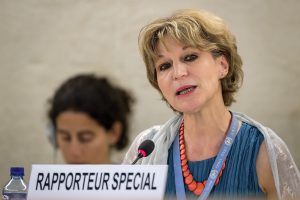
Under Executive Order 14203, the Trump administration has sanctioned ICC prosecutors, judges, and other officials, as well as leading Palestinian human rights groups al-Haq, al-Mezan and the Palestinian Center for Human Rights (PCHR) and the UN Special Rapporteur for the Human Rights Situation on the Occupied Palestinian Territory Francesca Albanese. US persons who violate the order face up to twenty years in prison and a one million dollar fine.
DAWN and the Taxpayer Alliance Against Genocide sued the Trump administration on July 15, 2026, in the US District Court for the Southern District of New York, charging that Executive Order 14203 violates Americans' First Amendment rights to speak, associate, and engage in Palestine-related human rights advocacy. Both organizations had sought assurance that from the Treasury's Office of Foreign Assets Control that their proposed work was permissible and received no response. The suit seeks a court order barring the administration from using the executive order to prevent from supporting investigations into U.S. and Israeli abuses, and from sanctioned human rights defenders. Courts have already in several other cases ruled against the government's interpretation of the sanctions. Separate legal challenges have also been brought by three sitting sanctioned ICC judges and several other human rights organizations.
The European Union's Blocking Statute, Council Regulation 2271/96, prohibit EU persons from complying with listed foreign sanctions, nullifies their effect in European courts, and allows Europeans to recover damages they cause. Its annex currently covers only US measures on Cuba and Iran. The Commission can add Executive Order 14203 by delegated regulation, as it did for US Iran sanctions in 2018. It has not done so. Slovenia raised the need for an EU response at the Foreign Affairs Council in June 2025. Spanish Prime Minister Pedro Sánchez called for activating the statute on May 6, 2026. UN human rights experts demanded on August 28, 2026, that Washington withdraw its sanctions and expressly called on the EU to activate the statute. The Commission has still not acted.
Article 70 of the Rome Statute criminalizes offences against the administration of justice, including impeding, intimidating, or corruptly influencing an official of the court to force that official not to perform their duties, and retaliating against an official on account of duties performed. The article contains no nationality requirement, and it carries a penalty of up to five years in prison. The court has used it before. In 2016, Trial Chamber VII convicted former Congolese Vice President Jean-Pierre Bemba and four associates under Article 70 for corruptly influencing witnesses, the court's first convictions for obstructing its own proceedings. The ICC President has previously described sanctions as an attack on its independence. The prosecutor has the authority to open an Article 70 investigation into the US officials responsible for these sanctions.